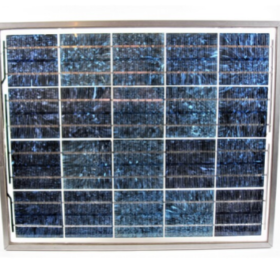
Solar module tech from oldest PV system in Netherlands
A solar panel on display at a science museum in the Netherlands is one of 2,748 modules that were used for the country’s oldest PV system. The module has an efficiency of around 9% and a power output of 18W. It was manufactured by Germany-based AEG-Telefunken in 1982.

All-polymer organic solar cell with 16.05% efficiency
The device achieved the highest efficiency and fill factor ever reported for an all-polymer solar cell based on polymerized small molecular acceptors. The cell was built with a top donor material known as PBDB-T and an electron acceptor made of the polymer PYT.
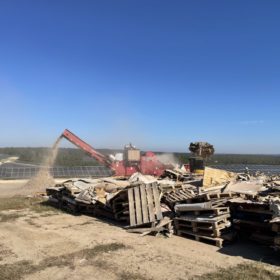
Millions saved with onsite mulching of solar trash
Florida utility FPL has been mulching solar panel packaging – cardboard boxes and pallets – to save approximately $130,000 per 75 MW (AC) site, compared to standard disposal practices.
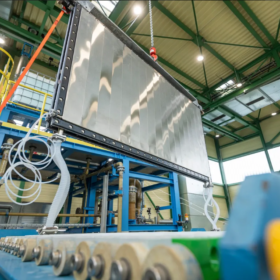
The Hydrogen Stream: More large scale hydrogen for Port of Rotterdam
Elsewhere, French renewable hydrogen startup Lhyfe has announced it is building an electrolyzer in eastern Germany, and Los Angeles-based Southern California Gas has launched a hydrogen-powered drone to monitor its gas grid.
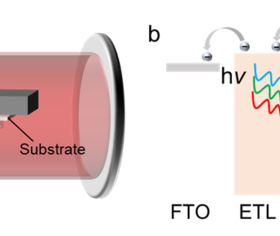
Cadmium selenide solar cell with 1.88% efficiency
The cell may be potentially used as a top subcell in tandem crystalline silicon-based devices. It was built with CdSe thin film with a direct bandgap of 1.72 eV.
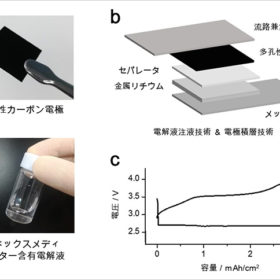
Japanese consortium builds lithium-air battery with energy density of 500 Wh/kg
A Japanese group has developed a storage system with potential applications in residential storage, electric vehicles, drones and Internet-of-Things devices.
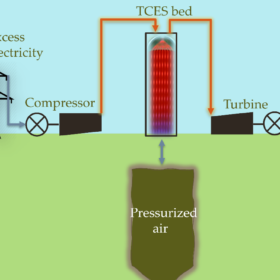
Improving compressed air energy storage efficiency via chemical reactions
Scientists in the United States have proposed to use a thermochemical energy storage (TCES) technique that stores energy in chemical bonds to recover the heat produced during air compression operations. According to them, this innovation may increase the round-trip efficiency of compressed air energy storage to 60%.
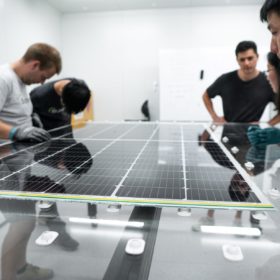
‘Ultra low-cost solar’ gets AUD 40 million R&D boost from ARENA
The Australian Renewable Energy Agency has announced AUD 40 million ($28.7 million) of research and development funding across two streams. Stream 1 consists of cells and modules, while Stream 2 is focused on balance of system, along with operations and maintenance. It is hoped the additional funding will spur Australia’s pioneering solar research to push for the federal government’s “ultra low-cost solar” target of AUD 15/MWh.
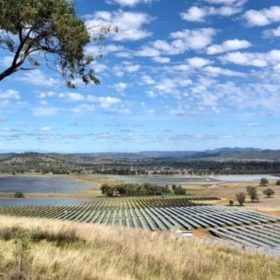
Lightsource bp to build 520 MW agrivoltaic project in Australia
The solar arm of oil major BP is proposing to build an agrivoltaic project in the Upper Hunter region big enough to provide 4% of New South Wales’ (NSW) electricity demand. The project will include 296 MW of storage capacity.
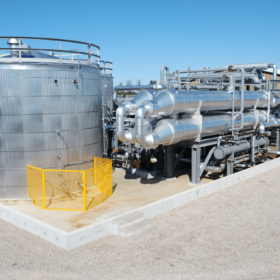
Goldman Sachs invests $250 million in Hydrostor to advance compressed air energy storage projects
The investment is planned to support development and construction of Hydrostor’s 1.1GW, 8.7GWh of Advanced Compressed Air Energy Storage projects that are well underway in California and Australia, and help expand Hydrostor’s project development pipeline globally.
