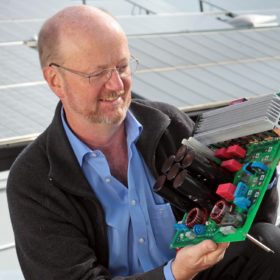
Fraunhofer ISE reaches legal settlements with seven inverter manufacturers who infringed its patent
In 2002, the Fraunhofer ISE patented the HERIC circuit for highly efficient inverters. Since then, the institute says, it has recorded out-of-court settlements in seven patent infringement lawsuits against companies from China, Taiwan and Germany.
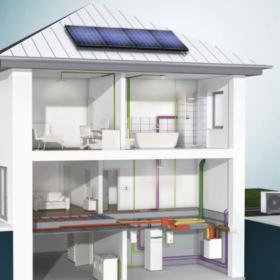
Short payback periods for PV-powered heat pumps in Spain
Spain’s National Confederation of Installers has released a technical paper about the advantages of coupling rooftop PV with heat pumps. It says that the payback time for a solar-powered heat pump can range between two and five years.
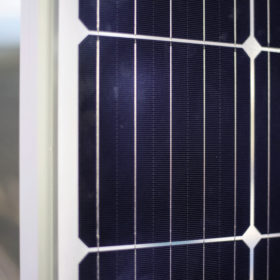
Powering up PERC-perovskite tandem cells
Perovskite-silicon tandem cells offer one of the surest pathways to much higher solar efficiencies, one that has moved close to commercialization in the past few years. Much of the work getting to this stage has naturally focused on developing a viable perovskite top cell. Optimizations to the silicon layer underneath, however, will also be important to the overall device function and efficiency. Scientists in Germany examined five different silicon cell concepts similar to those in mass production today, finding that with a few optimizations these could reach efficiencies up to 30.4%.

Iberdrola moves forward with Portugal’s largest pumped-hydro storage project
The Spanish energy company is building a huge hydropower complex across three water reservoirs in northern Portugal. The project will rely on 880 MW of pumped-hydro storage and is expected to become fully operational in 2024.
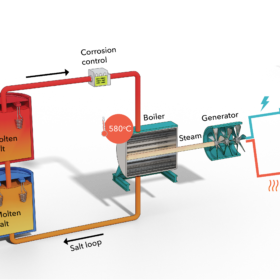
Storing solar power with grid-scale molten hydroxide
Seaborg Technologies, a Danish manufacturer of molten salt nuclear reactors, has turned a technology that was originally developed for nuclear power into a large-scale storage solution for wind and solar. It has developed a storage system that uses renewable energy to heat salt with electrical heaters, based on two-tank molten salt storage designs developed for concentrated solar power plants.
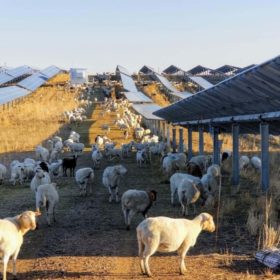
Grazing animals increase carbon sequestration by up to 80% in PV projects
Temple University researchers have found that managed sheep grazing on an acre of recovering agricultural soil with native plants may sequester 1 ton of carbon per year, which could accumulate for 12 to 15 years before reaching saturation.
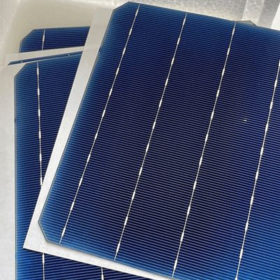
German consortium develops 19.7%-efficient PERC solar cells made of recycled silicon
Led by German research institute Fraunhofer ISE, the consortium has built the solar cells with 100% crystalline silicon recycled from end-of-life photovoltaic panels. The silicon is recycled through a technique conceived by German specialist Reiling GmbH & Co. KG and the Fraunhofer Center for Silicon Photovoltaics CSP.
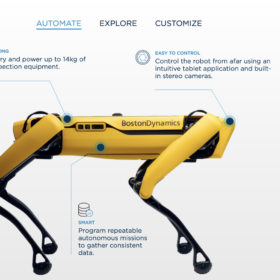
Robot dog for PV plant monitoring
Spanish renewable energy company Acciona is using a robot dog, instead of drones, to monitor a solar park in northern Chile. The device has a built-in thermal vision system that generates thermographic reports on the status of the different PV plant components, as it walks between the panel rows following a programmed route.
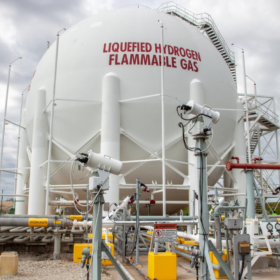
Large-scale storage options for compressed hydrogen
Researchers from Finland and Sweden have reviewed different ways to store compressed gaseous hydrogen, including storage vessels, geological storage, and other underground options.

Photovoltaics for curved surfaces
Researchers in Japan have used heat-shrinkable polymers to laminate organic photovoltaics onto curved surfaces. The process improves efficiency while minimizing damage to photovoltaic components.
