
Novel MPPT method combines APO, model-predictive control
An international research team has tested a hybrid control technique combining adapted perturb and observe (APO) with model-predictive control to address complex partial shading in solar arrays. The method, validated through simulation and physical experiments, reportedly outperforms existing approaches.

Impact of hydrogen on silicon solar cell degradation
German researchers have reviewed recent studies on hydrogen-related degradation in silicon solar cells. They said the work is timely, with n-type silicon dominating production and antimony-doping emerging.
‘Soft-connected’ floating PV for offshore scenarios
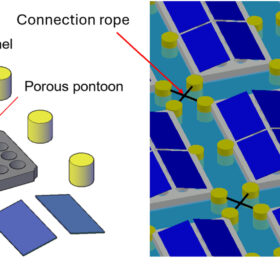
An international research team has tested a floating PV system with a “soft-connected” configuration under offshore conditions, using six modular pontoons linked by elastic bar elements to simulate mooring lines and connection ropes.

Passive solar module cooling tech based on atmospheric water harvesting
Researchers in India have developed a cooling technology that uses calcium chloride for atmospheric water harvesting. The system reportedly improves PV module yields by up to 18%.

New utility software to steer homeowner energy systems, enable load trading
Austrian startup Podero has launched software to enable utilities to roll out new residential services via its home energy device steering and trading solutions.

Smart Pension invests GBP 330 million in Octopus Energy clean-tech funds
UK workplace pension provider Smart Pension has announced an initial GBP 330 million ($440 million) strategic investment in Octopus Energy Generation. The renewables arm of Octopus Energy invests in solar, wind and energy storage projects, as well as clean energy technologies such as heat pumps.

A better understanding of UV degradation
Performance loss from ultraviolet (UV) light has become a concern for new PV cells, though earlier lab tests may have overstated the issue. Paul Gebhardt, photovoltaic module reliability scientist at Fraunhofer Institute for Solar Energy Systems (ISE), outlines a mechanism that may have distorted earlier results.
PV module fault diagnosis uses convolutional neural network
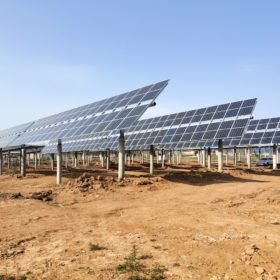
Researchers in China have created a dataset of various PV faults and normalized it to accommodate different array sizes and typologies. After testing the new approach in combination with the 1D-CNN machine learning technique under different conditions, they found an accuracy of more than 99%.
Power Roll tests perovskite solar panels outdoors
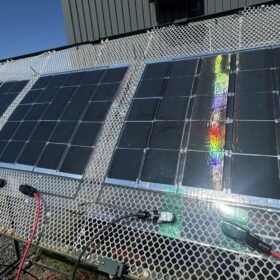
Power Roll, a UK developer of perovskite solar technology, has begun outdoor testing of its 600 mm x 400 mm flexible modules.
Cooling PV inverters with skived fin heat sink
Researchers in Turkey tested a novel heat sink design to cool insulated gate bipolar transistor (IGBT) arrays in solar inverters. They found that it reduced module temperatures by more than 6 C in lab experiments.
