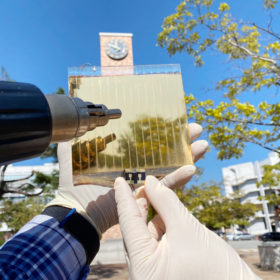
Ambient processed inorganic perovskite solar cells at 19.75% efficiency
Scientists in South Korea demonstrated a fabrication technique for perovskite solar cells relying entirely on room temperature, ambient conditions processes. Using an all-inorganic perovskite material, and a spray coated electron transport layer, cells fabricated by the group achieved a maximum efficiency of 19.75%.

The hydrogen stream: High gas prices mean cost competitiveness
New investments and partnerships announced this week see hydrogen projects developing across Europe, India, Asia and more. The current climate of high prices for natural gas has led one company to exclaim that green hydrogen is now competitive with its fossil fuel produced ‘grey’ counterpart, and research continues into optimizing hydrogen supply chains and smoothing its integration into the energy landscape.

The burgeoning underground scene of hydrogen storage
Underground hydrogen storage seems to be coming up a lot lately, and with the burgeoning hydrogen industry needing somewhere to store itself, it’s not hard to understand why. One of the countries with the best credentials for the future hydrogen economy is Australia. A newly published report has quantified the country’s “massive opportunity” for underground hydrogen storage.
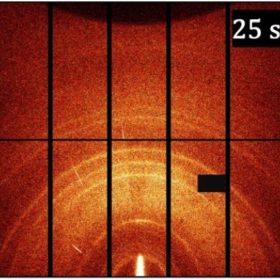
Laser focus on perovskite film formation
Scientists in the United States developed a method to observe the structure and mechanics of a perovskite material during its synthesis and transition from liquid precursors to a solid thin film. The group says its work will provide new insight into manufacturing and the development of reliable large-scale processes for perovskite solar cell production.
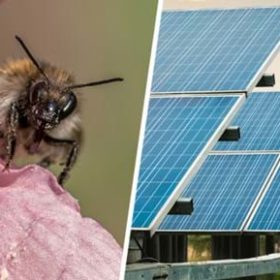
Solar farms prove to bee hives of economic activity
A new study from researchers at the universities of Lancaster and Reading in the UK has managed to quantify the economic boost provided by the symbiotic relationship between solar farms and honeybee hives.

A lightweight plastic to replace aluminum module frames
South Korean company LG Chem has developed a new plastic material that it says could replace the metal frame of a PV module, making it much lighter. The company says it has already secured mass production capability for the material and begun selling products at full scale.

Co-located hubs key to battery industry competitiveness
A report from Australia’s Future Battery Industries Cooperative Research Centre which analysed the development of battery hubs in the U.S., Germany and Japan, has found that co-location and cooperation between industry and government were key to their success. For Australia to play the same game, it will have to leverage its wealth of resources, and clean up its act along the way.

Nigeria’s solar workforce can help the world to net zero
With a rising chorus of voices calling for more solar industry recruits to perform the energy transition, Nigeria already has a skilled base of PV engineers and, with a little help filling the few gaps they have in their knowledge, the nation can step into the breach immediately, as Testimony Gabe-Oji, chief technology officer for Abuja-based installer Green Energy Spectrum, explains.

Drones, software key for intelligent PV plant monitoring
Mobile test equipment is a must for fault detection and performance monitoring of large-scale PV installations. The Australian PV Institute has contributed to an international review of available aerial and portable ground-based technologies, and how to deploy them for reliable, relatable results.
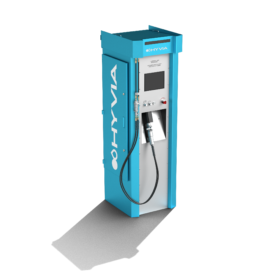
The Hydrogen Stream: $12 million financing for large-scale LH2 tank, new strategy for Australia’s NSW
Among other announcements, the U.S. Department of Energy has awarded financing to a consortium of public, private, and academic experts to demonstrate a large-scale liquid hydrogen LH2 tank, a new hydrogen strategy has been unveiled by Australia’s New South Wales (NSW) state government, and Repsol and EDP have teamed up to assess new investment opportunities in renewable hydrogen projects across the Iberian Peninsula.
