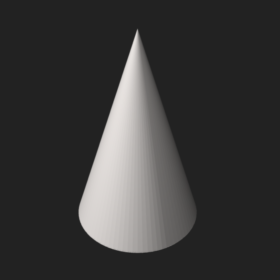
Conical-shaped solar panels cooled by forced airflow
A group of international scientists has compared the hypothetical performance of three novel shapes of solar modules – pyramidal, hexagonal and conical – and has found the latter has the strongest potential in terms of thermal behavior. According to their findings, a cooling technique based on forced airflow is key to making these solar module shapes into a feasible solution.
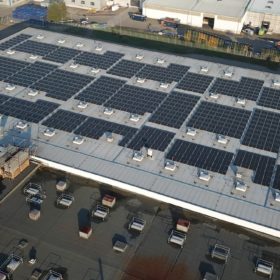
SMA, Renusol link planning tools
The German companies plan to combine their tools for project planning and battery systems via a new interface. They aim to simplify the work processes of planners and installers.
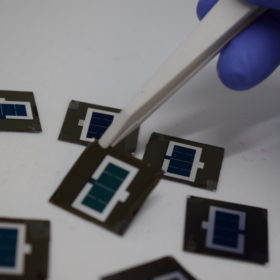
n-type perovskite tandem cell hits 27% efficiency
Scientists demonstrated a perovskite-silicon tandem cell that reached 27% conversion efficiency. Though higher tandem cell efficiencies have been achieved, this represents a big jump in efficiency for those utilizing n-i-p architecture, which previously had not surpassed 22%.
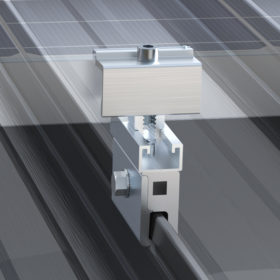
Sliding seam clamps for framed solar modules
The clamps can be installed on artisanal seam sheet roofs or industrial system seam sheet roofs made of coated steel, aluminum and other materials.
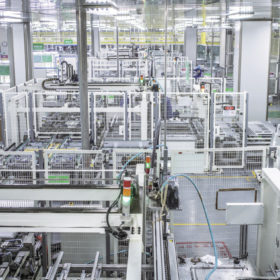
JinkoSolar claims 23.53% efficiency for n-type, TOPCon, monocrystalline panel
The PV module relies on Jinko’s TOPCon mono cell technology, for which a record efficiency of 25.25% was announced in late May. TÜV Rheinland has confirmed the result.
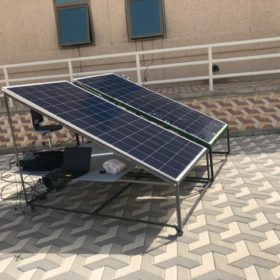
Solar module cooling techniques for the desert
Saudi scientists have tested several cooling technologies for solar panels and have found that active techniques work better than passive ones under harsh climatic conditions. The most effective one consists of a system based on four heat pipes immersed in a box of liquid, as liquid bulk, integrated with the back of the solar panel.
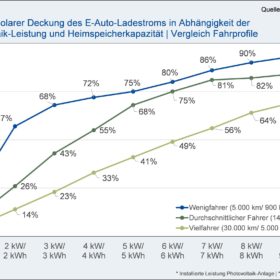
Solar+storage could provide 80% of annual EV power needs
A new EUPD Research report shows that a PV system can cover 39% of the power demand of an electric vehicle, but this potentially rises to 80% if storage is included.
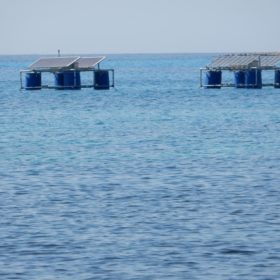
New floating structure for offshore PV, from Malta
The new floating structures can be made of light, reinforced concrete or similar materials, and are claimed to withstand 6m high waves. They can be utilized with standard photovoltaic modules that are currently available on the market.

Transforming lives with solar mini-grids
Smart Power India, a unit of the Rockefeller Foundation, has supported the installation of 9.2 MW of renewables-based minigrids at more than 300 sites across India. Jaideep Mukherjee, CEO of SPI, recently spoke to pv magazine about the importance of minigrids and barriers to deployment.

New research points to cheaper green hydrogen by 2030
New modeling by Monash University researchers has shown that the cost of green hydrogen with solar PV could satisfy the Australian government’s economic stretch goal of AUD 2 ($1.50) per kilogram by as early as 2030.
