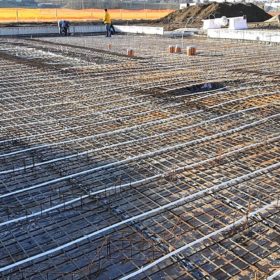
Excess PV power to activate floor heating in commercial buildings
Austrian heat and PV specialist my-PV is proposing a new solution to use surplus PV electricity for thermal concrete-core activation in commercial buildings.
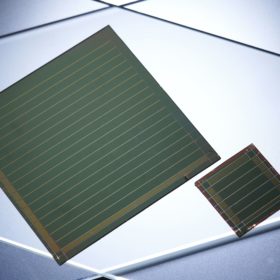
Large-area perovskite solar module with 18% efficiency
Researchers in Germany claim to have overcome the main challenge for the development of large-area perovskite PV modules – scaling up from the cell to the module level. They achieved an efficiency of up to 16.6% on a module surface of more than 50 centimeters squared, and 18% on a module with an area of 4 centimeters squared.
Enabling aluminum in batteries
Scientists in South Korea and the UK demonstrated a new cathode material for an aluminum-ion battery, which achieved impressive results in both specific capacity and cycle life. The material allows researchers to better take advantage of aluminum’s energy storage characteristics, and produce batteries with much higher capacity.

The Hydrogen Stream: Offshore hydrogen pipeline and more electrolysis capacity in Germany
Big German conglomerates such as Siemens, RWE and Vattenfall keep pushing for green hydrogen development through different projects. Germany’s first offshore hydrogen pipeline is being planned by RWE itself, Shell, Gascade and Gasunie, and should be commissioned in 2035. Siemens is planning hydrogen projects in the 5 MW to 50 MW range, for industrial and mobility applications.
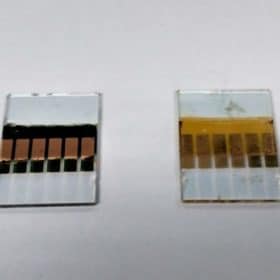
Solid-state solar cells based on metal-organic framework nanomaterials
Spanish scientists have fabricated solid-state PV cells with two different porous nanomaterials. Although low in terms of efficiency, one of the cells built with the MIL-125(Ti) metal-organic framework nanomaterial exhibited better photovoltaic performance than similar devices.

Silicon carbide passivating contact for 24%-efficient crystalline solar cells
The special passivating contact is claimed to feature high transparency, good conductivity, and at the same time, to offer enough hydrogenation for passivation. The cell built with this contact achieved an open-circuit voltage of 725 mV, a short-circuit current density of 40.87 mA cm−2, and a fill factor of 80.9%. Its certified efficiency was 23.99%.

German organizations outline new standards for agrivoltaics
Representatives from 15 agricultural and solar businesses, research entities, and certification bodies in Germany have developed DIN SPEC 91434, a new set of proposed standards for agrivoltaics.
Doping and capping promise perovskite stability
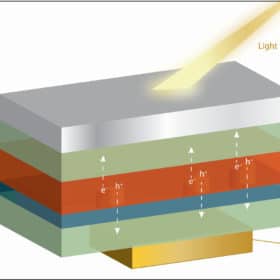
Scientists demonstrated two new approaches to improving the stability of perovskite solar cells. By both incorporating rubidium into the structure of the perovskite, and adding a film of two-dimensional perovskite as a capping layer, they were able to demonstrate a significant reduction in the cell’s sensitivity to moisture. The group says its research will open up new routes to improved performance and stability in perovskite PV.
Vortex generators and glass texturing for solar module cooling
New research from Australia has shown that vortex generators and glass texturing have so far proved to be the most effective solutions among the novel methods explored for lowering the temperature of solar panels.

How to attract bees into solar parks
According to new research from the U.K., solar parks may help maintain natural habitats for pollinators that could be, otherwise, destroyed by intensive farming. The study also highlights that biodiversity could be both positively and negatively affected by solar parks and associated land-use change.
