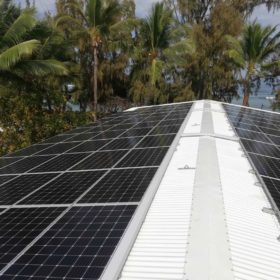
Air conditioning powered by self-consumed PV
French company Sirea has installed one of its energy management systems on a rooftop PV plant that is connected to an air conditioning system at a school on Reunion island. The system can help manage four real-time measurement points: photovoltaic production, withdrawal and injection into the distribution network, consumption of cooling units, and building consumption.
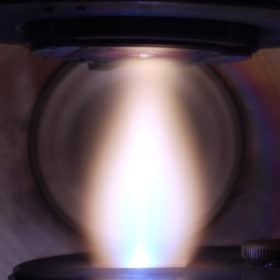
Performance improvements for anomalous photovoltaic effect
A German research team has created a new solar cell architecture with self-assembled, three-dimensional nanocomposite thin film. The special cell configuration purportedly improves electrical output by a factor of five.

Novel catalyst produces green hydrogen from seawater via solar
Australian and Chinese researchers have developed a novel catalyst for the production of green hydrogen from seawater via solar.
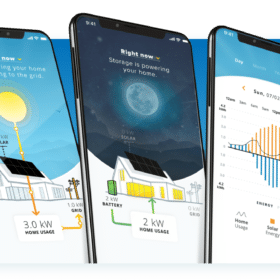
SunPower launches home monitoring app for solar, storage
The SunPower solar monitoring app draws inspiration for its user interface from unlikely non-energy sources such as Spider-Man.
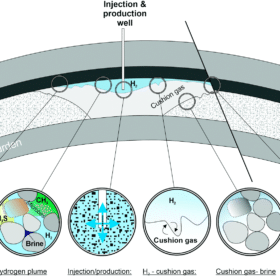
Key challenges for underground hydrogen storage
An international research team has presented challenges and knowledge gaps in the implementation of large scale underground storage of hydrogen. The main issues associated with this technology relate to the fluid flow behavior of hydrogen in subsurface reservoirs, geochemical reactions caused by hydrogen injection, biotic reactions caused by excess hydrogen, and the geomechanical response of the subsurface to hydrogen storage.
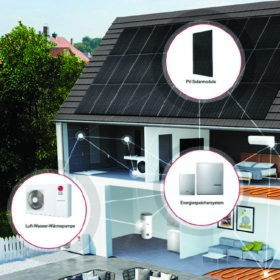
LG Electronics offers hybrid system combining heat pump, PV and storage
The system generates electricity and heat for residential houses and small businesses. An integrated energy management system should guarantee maximum self-consumption of the solar power produced.
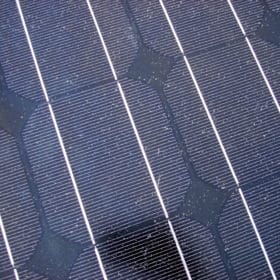
Active self-cleaning tech for PV modules
An international research team has developed a cleaning system for solar panels that combines a vibrating device with the use of hydrophilic curved rungs. The technique is claimed to be able to remove the surface contaminants through the internal flow of vibrating water droplets applied with a pipette onto the module surface and transported, under vibration, to the contaminated parts.
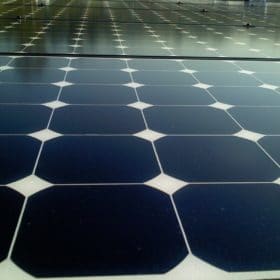
Stochastic fractal search algorithm to measure parameters of PV modules
An international research team has used, for the first time, a powerful metaheuristic and a nature-inspired algorithm to improve the estimation of the parameters of PV cells and modules. The algorithm imitates the natural phenomenon of growth and uses the diffusion process, based on random fractals.
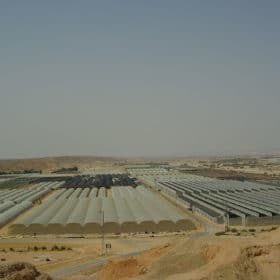
Israeli government wants to boost development of agrivoltaics
The Israel Ministry of Energy and the Ministry of Agriculture have decided to implement a pilot research program to assess the feasibility of agrivoltaic projects in the country. The possibility of combining PV and agriculture in a land with limited land availability and increasing energy demand is considered a win-win solution by the government.

Panasonic to exit solar manufacturing
The Japanese brand will continue to sell third-party-made modules under its brand in its home market, as it already does overseas, but in-house PV wafer, cell and module production will halt by the end of fiscal year 2022.
