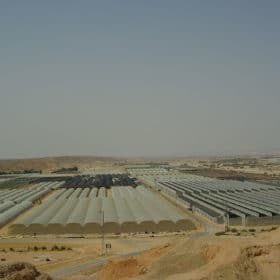
Israeli government wants to boost development of agrivoltaics
The Israel Ministry of Energy and the Ministry of Agriculture have decided to implement a pilot research program to assess the feasibility of agrivoltaic projects in the country. The possibility of combining PV and agriculture in a land with limited land availability and increasing energy demand is considered a win-win solution by the government.

Panasonic to exit solar manufacturing
The Japanese brand will continue to sell third-party-made modules under its brand in its home market, as it already does overseas, but in-house PV wafer, cell and module production will halt by the end of fiscal year 2022.

Dual passivation tech for 20.14%-efficient perovskite solar cell
Europium ions have been used by Chinese researchers to passivate both the perovskite and electron transport layer (ETL) films of a MAPbI3 perovskite solar cell. As a result, the device’s efficiency was raised by approximately 1.5%. The dual passivation approach also achieved an increase in the cell’s fill factor and open-circuit voltage.
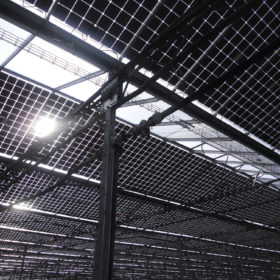
Boosting bifacial panel efficiency with albedo ground covers: Field test results
Tests by 7X Energy show that ground cover material showed promise, but projects will likely still need to prove the long-term durability, degradation rates, and validation of installation labor and O&M.
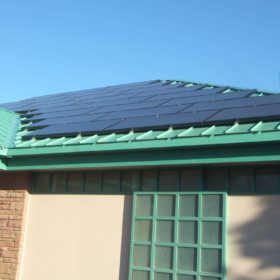
Flexible heat pumps ideal for power grids congested by solar and wind
Dutch transmission system operator Tennet, which also serves Germany, is planning to create flexible electricity demand and reduce grid congestion by promoting the use of smarter heating systems and heat pumps that can also be powered by solar and wind energy. According to its experts, intelligent control of heat pumps may result in the creation of between 0.5 and 1 GW of temporary grid flexibility by 2030.
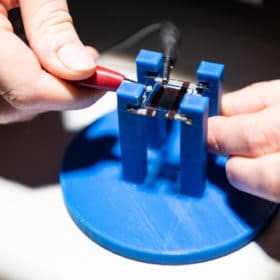
Inverted perovskite solar cell with transition metal carbides achieves 19.2% efficiency
A Russian-Italian research group has developed a two-dimensional transition metal carbide, known as MXenes, to collect photocurrent in perovskite cells. The cells were built with an inverted configuration and are based on a nickel(II) oxide hole transporting layer. The scientists claim that the doping technique allowed them to increase the efficiency of the cell by more than 2%.

Solar-powered hydrogen for Masdar City
Masdar is launching a pilot green hydrogen project in the United Arab Emirates. In a recent conversation with pv magazine, two company officials described the project and explained how the hydrogen will be used for road transport, aviation and shipping in Masdar City.
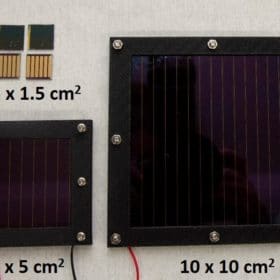
Mini perovskite solar module with 14.55% efficiency
The 5x5cm device was developed by a Japanese research group. The thickness of the perovskite films was increased to reduce defects and pinholes and this was achieved by adding ammonium chloride to the lead iodine solution used in the formation of the films. The device was able to work for 1,600 hours at more than 80% of this efficiency.

European Commission approves further €2.9bn battery research project
Companies from a dozen EU member states will commit the public funds in a bid to come up with novel battery chemistries and production methods as well as recycling and circular economy innovation.
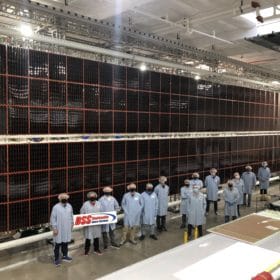
Boeing brings more PV power to NASA International Space Station
Six new arrays with a combined capacity of 120 kW will be installed on the International Space Station starting from this year. The panels will be brought to the station with the SpaceX Dragon cargo spacecraft during three resupply missions. The installation of each solar array will require two spacewalks.
