
REC Silicon could restart poly production at Moses Lake
The Norwegian polysilicon maker has been been frozen out of the Chinese solar market by political tensions between Beijing and the U.S. and mothballed its Washington State production line last year. However, two recent business agreements could change all that.

Plasma passivation process to cut silicon cell costs
Scientists in Saudi Arabia have developed a new passivation process for n-type silicon solar cells, which they say could offer a simpler, lower-cost alternative to current processes used in manufacturing. The group fabricated wafers using this process with promising results, and now plans to integrate the process into a full silicon cell.

Mini perovskite solar panels with 18.4% efficiency
Researchers in Singapore have developed a 6.4 cm2 solar module based on co-evaporated methylammonium lead iodide (MAPbI3). They claim that the panel is a step forward in the industrialization of perovskite mini-modules.

The issues with lithium-ion battery recycling – and how to fix them
Design-for-recycling is not perceived to be high up the list of priorities for battery manufacturers but solutions do exist. Lithium-ion device recycling is technically feasible but requires an improvement in its business case to take off.

South Korea follows Japan with net-zero 2050 pledge
Re-elected South Korean president Moon Jae-in today declared he will follow-up on a campaign trail promise to eliminate carbon emissions by mid century. The announcement comes just two days after Japan’s new prime minister said he would accelerate his nation’s emissions target.

Modular raft system for floating PV plants
Qi-energy and Candock have developed a raft-based system for utility-scale floating PV plants, based on special high-density polyethylene “dock cubes” supporting a nonmetallic frame.

Triple junction perovskite cell hits 16.8% efficiency
Scientists in the Netherlands fabricated three different perovskite layers, all using the same process. The three cells are all tuned to different bandgaps in order to absorb different wavelengths of light. A triple-junction device incorporating all three achieved 16.8% conversion efficiency. This, the researchers say, is a promising result for the technology, though would require the development of new wide-bandgap perovskites to push much further.
UK utility trials ‘world first’ renewables-friendly energy market
UK Power Networks’ ‘Power Potential’ project offers small scale generators the chance to be rewarded for voltage-balancing reactive-power services alongside traditional power stations.
Fraunhofer to develop battery inverter for whole-area UPS and renewables integration
Industrial and academic partners are developing a battery inverter which can be grid connected under normal operation but can also use nearby renewables generators to form an island grid, for whole-area uninterrupted power supply.
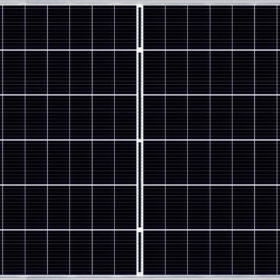
Canadian Solar launches 640-665 W panel series
The HiKu7 CS 7N-MS series is available with power output ranging from 640-665 W and efficiency ranging from 20.6-21.4%. The panel, which is the most powerful product the company brought to the market to date, is considered ideal for utility-scale and commercial and industrial PV projects.
