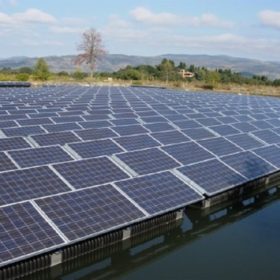
Investigating bifacial for floating PV
Scientists led by the University of Ontario modeled the performance of bifacial modules in floating PV applications, finding that in a north/south orientation at a 30 degree angle, the modules could receive as much as 55% more sunlight than a monofacial module in the same setup.

Gallium arsenide phosphide tandem solar cell with 25.0% efficiency
The demonstrated device, according to the academics, is built with interfaces between the active cell layers that improve the top cell carrier collection. The cell was built with texturing and a hydrogenated amorphous silicon (a-Si:H) passivation of a silicon back surface.

Copper metallization process reaches pilot production in Germany
Scientists led by staff from Germany’s Fraunhofer ISE have demonstrated a new laser printing process in pilot production, which could replace silver paste and screen printing in solar cell manufacturing. The system is said to offer much more flexibility in the layout of contact fingers on the cell surface and a wider choice of metallization materials.

Improving outdoor I-V curve measurements with PV module irradiance sensors
Japanese scientists have replaced common pyranometers with PV module irradiance sensors to measure the I-V curves of crystalline silicon PV modules. The sensors provide highly precise outdoor measurements, the researchers said.

Concentrating photovoltaic-thermal system with 91% efficiency
A global research team has developed a parabolic trough linear concentrating photovoltaic-thermal system to produce heat and electricity, for both residential and large-scale applications. The PV unit relies on Azure Space’s multi-junction solar cells, based on indium gallium phosphide (InGaP), gallium arsenide (GaAs) and germanium (Ge).

Australian startup to replace silver with copper in solar cell manufacturing
Startup SunDrive has secured US$2.2 million in funding from the Australian Renewable Energy Agency to help scale its low-cost, high-efficiency solar cell manufacturing process.

Port of Rotterdam micro-market trial boosts battery storage returns 20%
A small-area trial of artificial intelligence and blockchain-based energy trading software demonstrated big improvements across all renewable energy performance metrics. The port authority now wants the system across all its premises.
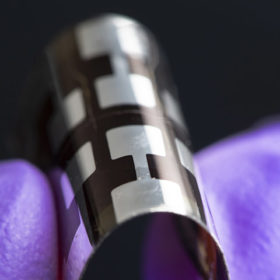
NREL scientists build all-perovskite tandem solar cell with 23.1% efficiency
The U.S. based researchers have developed a new wide-bandgap perovskite layer – called Apex Flex – which they claim is able to withstand heat, light, and operational tests, and at the same time provide a reliable and high voltage. With this material, they built tandem solar cells with 23.1% power conversion efficiency on a rigid substrate, and 21.3% on flexible plastic.
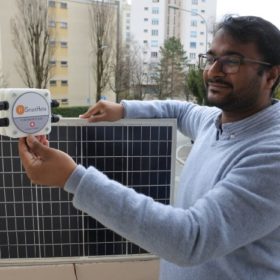
Swiss solar monitoring start-up raises $272,000
SmartHelio claims to have witnessed a near 200% jump in demand for its deep-data driven solar asset management solution, which plugs into solar panels or energy storage systems. Sales of the internet-of-things enabled, cloud product have leapt in the last six months.
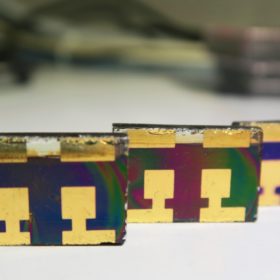
Chemical assist for stable perovskite cells at 23% efficiency
Scientists at the École Polytechnique Fédérale de Lausanne have developed a new ‘chemical innovation’, for the deposition of perovskite solar cells onto a substrate. The method is shown to produce cells at better than 23% efficiency, that remained stable after 500 hours testing at a raised temperature.
