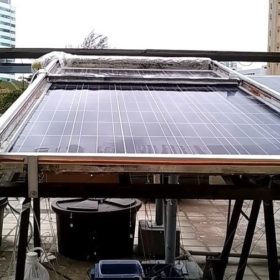
Self-cleaning PV system with active cooling tech
An international research group has developed a self-cooling PV system featuring a 250 W 60-cell polycrystalline module and a thermal collector attached to the back side of the panel. The cleaning tech is based on a microcontroller programmable integrated circuit, which controls a rotating DC motor.

New chemistry promises better lithium sulfur batteries
Scientists in the U.S. have developed a new cathode chemistry for lithium-sulfur batteries, which they say promises to overcome performance issues stemming from sulfur’s low conductivity and tendency to react with lithium.

European consortium bid to bring 25.4%-efficient heterojunction-IBC solar cell into mass production
The EU-funded Nextbase project aims to manufacture heterojunction, interdigitated back-contact solar modules for less than €0.275/W. Solar panels featuring the Nextbase cell tech are expected to have a conversion efficiency of 23.2%, according to the European Commission.

Low-cost direct solar-to-hydrogen ambitions see the light
The road to cheap hydrogen production is riddled with potholes and energy losses. Researchers in Australia have demonstrated rethinking solar technology and skipping electrolysers could hold great promise for reaching the hydrogen holy grail.
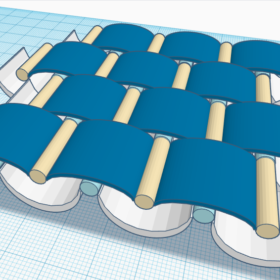
Parabolic bifacial module with active cooling system
Scientists in Morocco have designed a new bifacial module with a cooling system, based on bifacial parabolic solar cells that are connected to each other via tubes for panel cooling. They are now patenting the tech, but have yet to manufacture an initial prototype.

Graphene doping a step forward for sodium batteries
Scientists at Switzerland’s École Polytechnique Fédérale de Lausanne (EPFL) have developed an anode from graphene doped with sodium, which they say could potentially overcome some of the fundamental issues in increasing storage capacity and the lifetime of sodium-ion batteries.
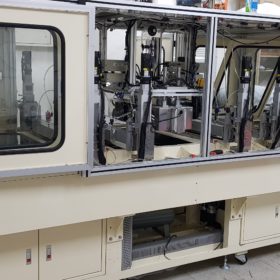
New production equipment for large-area perovskite solar cells
National Taiwan University and Taiwanese PV production equipment provider E-Sun Precision Industrial Co. have developed equipment to produce different kinds of perovskite cells with varying chemical compositions. The first trials achieved 14.3% conversion efficiency rates.
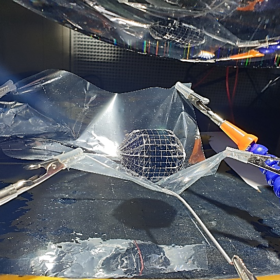
Spherical monocrystalline solar cells with 18.93% efficiency
The spherical 3D cells can reportedly generate around 101% more power than conventional flat solar cells. Measurements have also shown that the spherical cells provide a 10% lower maximum temperature compared to flat cells, while accumulating less dust.

Hanwha Q-Cells wins patent litigation against JinkoSolar, REC Solar and Longi in Germany
The Düsseldorf Regional Court has agreed rivals of the Korean manufacturer illegally used its patented passivation technology. The judges granted Hanwha Q-Cells an injunction which requires Jinko, REC and Longi to retrieve all modules featuring the patented technology distributed in Germany since late January last year. Hanwha can also opt to have the offending products destroyed.

Scientists in China give flexible perovskites a backbone
A team of researchers led by Nanchang University in China trialed a polymer based hole transport layer to flexible perovskite solar cells, using a glue to attach it to the active perovskite. The team was able to assemble the 19.87%-efficient cells into a small flexible module suitable for wearable solar applications, and says its design was inspired by the structure and movements of human vertebrae.
