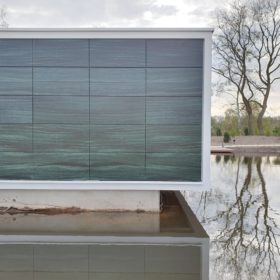
Wood-like solar facades
Taiwanese manufacturer Heliartec Solutions is offering BIPV panels for building facades that can be designed to mimic different kinds of textures in conventional building materials. The panels can also work as colored laminated safety glass and replace traditional cladding in the ventilated facades of buildings. They vary in length from 60 cm to 240 cm, with widths ranging from 30 cm to 120 cm. Depending on their size, the panels can offer power outputs of 90 W to 150 W per square meter.

Solar inverters vs. cyberattacks
A U.S. research group is now developing new inverters to protect solar installations from cyberattacks. The researchers also aim to create new cybersecurity standards. Professor Alan Mantooth, the group’s research coordinator, said that inverters can be shut down if they are hacked, or contribute to grid instability and result in the overcharging of batteries, while potentially creating problems that we still don’t know how to address.
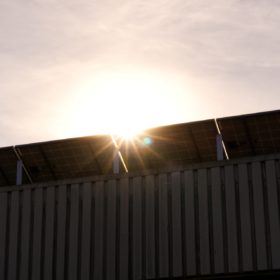
New technique to determine best cooling technique for solar modules
A new paper published by researchers at Malaysia’s Multimedia University provides a new method to assess the effectiveness of different cooling systems for photovoltaic modules. The proposed technique relies on measuring the output of the module with added cooling and comparing this to its power rating under standard test conditions.

A closer look at clouds to optimize energy forecasts
A group of scientists in the United States has developed a weather forecasting model designed to better predict the solar irradiation that a given area will receive. The model uses satellite data to estimate the light transmission properties of clouds, a metric often overlooked in standard weather forecasting, but nonetheless vital in modeling PV energy yield.
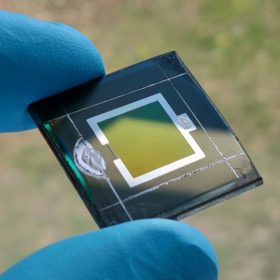
HZB scientists announce 24.16% efficiency for tandem CIGS solar cell
The Fraunhofer Institute for Solar Energy Systems’ (ISE) CalLab has confirmed the new efficiency rating. The researchers have combined semiconductors, perovskites and CIGS to produce a monolithic two-terminal tandem cell.

Ultrathin, flexible solar cell with 13% efficiency
Researchers at Monash University in Australia have managed to develop a solar cell so ultralight and flexible that it could revolutionize the future of wearable tech.
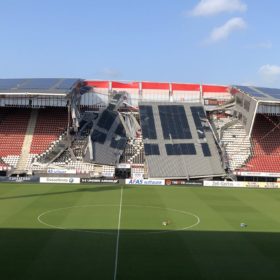
Solar cleared in damages to Dutch football stadium
A failed top rail girder connection was responsible for the 2019 roof collapse at AZ Alkmaar’s football stadium, an investigation by Dutch engineering firm Royal HaskoningDHV has revealed. The collapse was triggered by strong wind loads during a storm.

ClearVue’s luminescent solar concentrators create clear PV windows
The lure of building integrated photovoltaics continues to attract entrepreneurs and startups.
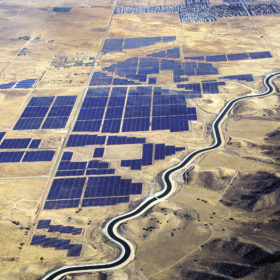
JinkoSolar says US authorities see no violation of Hanwha Q-Cells patent
The patentability of Korean company Hanwha’s technology is being examined by a U.S. commission, according to Jinko. The Chinese manufacturer said it expects a final decision by December. Hanwha responded by announcing its decision to appeal.
Redox flow batteries for $66/kWh from steel industry waste
U.S. researchers claim to have added iron sulfate to anthraquinone disulfonic acid in a redox flow battery for the first time. The scientists said the combination could lead to inexpensive and more stable redox flow storage for just $54/kWh and said $66/kWh is already possible.
