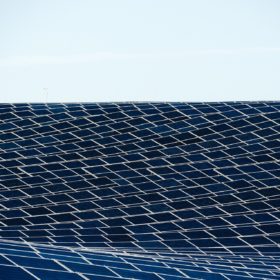
A dual-angle approach to building solar plants at higher latitudes
A research team in the US has proposed a ‘dual-angle solar harvesting’ method it is claimed could help PV developers optimize energy yield and land use. It is claimed the method would be particularly suitable for projects in cloudier climates and at higher latitudes.
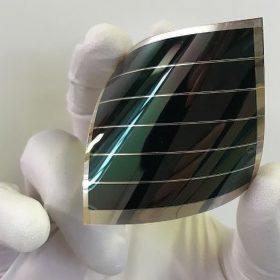
An organic solar cell with 25% efficiency
The ‘best conversion performance in the world in a dark room’ is how the developers of a new organic PV device have described it. Such cells could be used as a wireless source of energy for internet of things applications or in gadgets such as temperature-humidity and motion sensors.

Can a transparent solar window harvest enough power to be economical?
Can an organic solar cell material finally be commercialized? Last year, Ubiquitous Energy claimed a world record for efficiency of a “transparent solar cell” with a “certified” 9.8% efficiency.
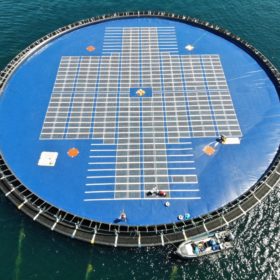
Floating PV learning from aquaculture industry
The CEO of Norwegian floating solar company Ocean Sun has spoken to pv magazine about his company’s innovative design for floating PV projects in near-shore locations and semi-sheltered waters. A pilot project built in the Philippines last year, said Børge Bjørneklett, is providing better-than-expected power output.
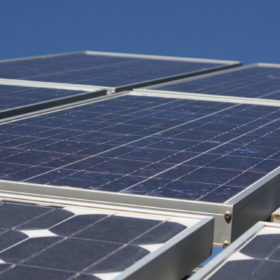
Predicting the I-V characteristics of PV systems under partial shading
Researchers in Tunisia have proposed a method of determining the characteristic I-V profile of a partially shaded PV module, and to extrapolate it into a string profile.
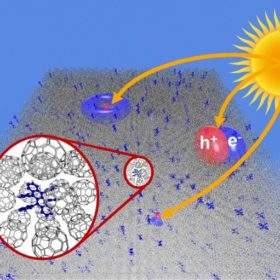
Bad vibes for organic solar cells
Researchers in Germany and Belgium have discovered ‘zero point vibrations’ are responsible for performance limitations in organic solar cells. New strategies to minimize such vibration-induced voltage losses in organic PV should be investigated, say the scientists.

More efficient underwater PV cells with wide-band gap semiconductors
U.S. researchers have conducted detailed balance calculations to show the ultimate potential of underwater solar cells. According to their findings, the devices could theoretically produce useful power at up to 65% efficiency in clear waters. However, this would only be possible by using wide-band-gap semiconductors, which have not been considered for solar cells used for land-based applications because their band gaps are too large.
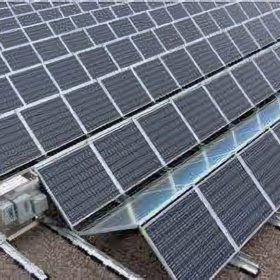
Raising a PV system’s yield by 20% with mirror reflectors
A group of Scientists in India has demonstrated a 20% increase in a PV system’s energy yield through the use of mirror reflectors in the summer season. Though the technology is still far from being economically viable, the research shows that higher power yields can be reached without significantly affecting the module temperature.
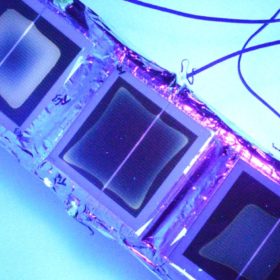
Identifying early-stage discoloration in EVA encapsulants
A new, non-destructive method has been proposed by researchers in India who say identifying early-stage discoloration in EVA encapsulants can help detect degradation in solar panels before power output is affected. The scientists used an ultraviolet accelerated aging test during 34 days on three encapsulant samples.
Four challenges to solid-state battery scale-up
A paper by scientists at the University of California San Diego has outlined a technology roadmap for the development of solid-state batteries – and four challenges to address for the technology to advance.
