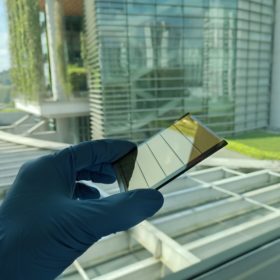
Mini perovskite module with 18.13% efficiency
Scientists from Singapore have developed semi-transparent perovskite solar cells that can be easily integrated into a range of urban contexts, including building facades, gates and windows. The 21cm2 mini panels are made of perovskite solar cells based on methylammonium lead iodine (MAPbI3), with an efficiency of 20.28% for 0.16 cm2.
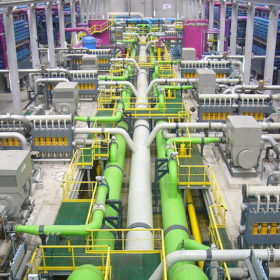
Solar can drive down levelized cost of desalinated water
A study from Finland’s Lappeenranta University of Technology states decarbonization of desalination could help achieve a levelized cost of water of €0.32-1.66 per cubic meter. Solar and storage are expected to play a decisive role.

Australian researchers shine light on potential storage solution
Researchers at the Queensland University of Technology have proposed a new design for a diamond nanothread bundle that could pave the way for a new form of mechanical storage. Pound-for-pound, the tech could be three times more powerful than lithium-ion batteries.

The week in perovskites
As a focus of research at leading institutes the world over, new developments in the perovskite field come thick and fast almost every week. From x-ray observations on a nanoscale to financing and plans for mass production, pv magazine is bringing together some of the most exciting developments of recent weeks.
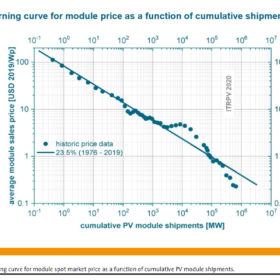
Solar costs set to continue falling according to ITRPV roadmap
The 11th edition of the German document which tracks solar price falls and efficiency improvements has considered the role bigger wafers are playing in cost reduction.

Single‐walled carbon nanotubes for more efficient III‐V solar cells
Russian researchers have improved the efficiency of a thin-fim GaAs‐based solar cell by 0.9% by applying single‐walled carbon nanotubes as the topmost layer. The cell also showed a slight increase in the short circuit current density, from 16.9 to 17.9 mA/cm2.
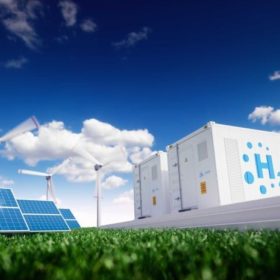
The solar highway to Australia’s renewable hydrogen economy
The Australian Renewable Energy Agency says that on-site solar electrolysis is not just the most cost-effective way of developing a domestic and export hydrogen economy, but perhaps the only way.

‘Free-form’ organic PV
French organic PV module manufacturer Armor said it began manufacturing free-form PV modules in early April. The new technology will allow the company’s ASCA PV film to be produced in a range of different shapes.

Is deep-sea mining eco-friendlier than land-based mining?
The International Seabed Authority will change regulations for deep-sea mining this year. The ocean floor is covered with potato-sized pebbles containing high levels of cobalt, manganese, nickel and copper – materials that could soon be in short supply as the energy transition progresses.
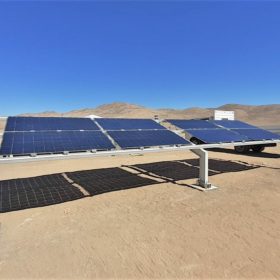
Bifacial panel made in Chile
Atamostec, a private-public initiative supported by Chile’s government-run Production Development Corp. and several industrial partners, has developed a new module. The team claims that the bifacial panel offers an additional annual average gain of 11% compared to monofacial PERC modules with the same cell technology.
