Longi demonstrates 20% bifacial boost
In a white paper published this week, Chinese module maker Longi Solar shares six months of data from a testing site in India that was built in cooperation with German testing institute TÜV Rheinland. The results show energy yield gains of around 20% for both bifacial mono PERC and n-type modules.

Pxise: Operating the future grid, today
As higher concentrations of renewable energy and storage capacity come online, the control systems of today cannot solve the problem of a two-way predictable grid of the future. Enter Pxise Energy Solutions (pronounced “Pice”). Using real-time data and algorithms to make intelligent decisions, the company’s software technology is breaking down barriers for grids to operate with high levels of renewable penetration. Pxise says its software can unleash the benefits that batteries are able to provide.

Swimming electrons in perovskite nanocrystals
Research from Canada has revealed liquid-like lineshape dynamics in cesium-lead iodide perovskite nanocrystals. The findings could be used to produce cheaper and more efficient perovskite cells, researchers claim.
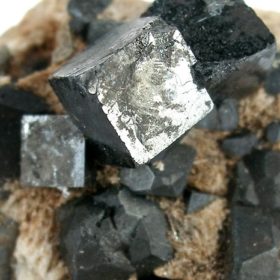
Straining to fix perovskite cells
A technique based on optical imaging has been used by an international research team to illuminate strains in lead halide perovskite solar cells without harming them. The scientists claim the approach helped them discover misorientation between microscopic perovskite crystals was the main cause of the strains.
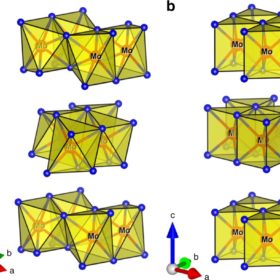
Scientists double down on hydrogen production
A team of scientists led by the University of Glasgow has discovered a more efficient method of splitting water into hydrogen and oxygen using electricity which it says could almost double the amount of hydrogen produced per millivolt.

PV to address water scarcity
The government of the Philippines will spend $500 million on solar-powered water supply and desalination in remote areas of Mindanao, the second-largest island in the archipelago. Elsewhere, a Finnish study has suggested drought-hit Iran could benefit from renewable-powered desalination.
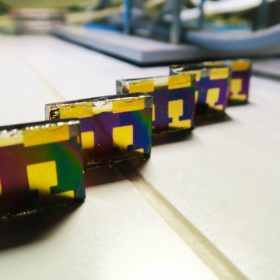
Perovskite solar cells need proteins
A U.S. research team has used protein bacteriorhodopsin to improve the efficiency of what it called ‘bioperovskite’ solar cells. The scientists used Förster Resonance Energy Transfer to predict the strength of long-range excitonic transport between the perovskite and protein layers.

PV against cancer
Research from the United States has demonstrated how PV technology can be used to kill cancer cells. Although still at an embryonic stage, the findings of the study and initial test results suggest solar power could be an effective tool in relation to light-activated fluorescent dyes for disease diagnosis, image-guided surgery and site-specific tumor treatment.

UK’s Labour announces plans for 22 GW of new solar capacity by 2030
Although PV trails wind and nuclear in terms of its anticipated future footprint, the opposition party’s attempt to outflank left of center rivals on climate change has resulted in one of the world’s most ambitious national roadmaps towards a zero-carbon future.
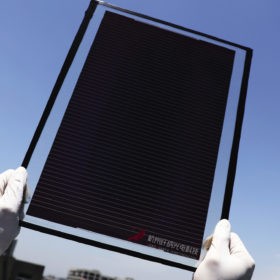
Microquanta achieves 14.24% efficiency with large-area perovskite solar module
The four-year-old Hangzhou-based business says it already has a 20 MW perovskite module pilot line and is working on a mass production facility in the city of Quzhou.
