MIT researchers put slimmer silicon back on the table
With solar grade polysilicon prices having plummeted in recent years, cutting down on consumption of the material has not been a priority. But strategies exist and significant savings can be made through deploying thinner wafers that use less silicon, insists a new paper published by MIT and NREL. And as manufacturers are increasingly hitting dead ends on other routes to cost reduction, this option could be back on the table for many.
A new technique to get the right angular-tilt
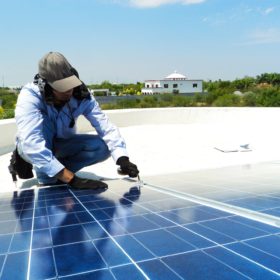
UK scientists are proposing a new approach to calculating the optimum angular-tilt of PV panels for a planar surface at a particular site. In their view, the new technique may unlock innovative yield optimization methods for the installation of PV systems.
Raising the efficiency of polycrystalline cells with new luminescent EVA film
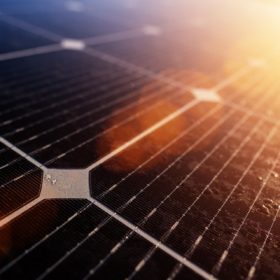
Chinese researchers have developed a pure EVA film, which they claim can enhance the conversion efficiency of conventional crystalline solar cells by around 0.50%. The film is able to convert UV light into strong visible light.

ERA-Net awards 23 future energy pilot projects across Europe
Under the umbrella of the European Union’s Horizon 2020 initiative, the research platform ERA has initiated a new batch of future energy projects. Looking at the list of winning projects, it is easy to tell that hydrogen, virtual power plant, and blockchain projects are really at the center of what Europe thinks will be important for its net-zero carbon plans by 2050.
How much can you wash a wearable PV device?
UK researchers claim to have proved the viability of wearable photovoltaic devices as an integrated part of regular clothing. A solar-powered fabric textile was created by embedding micro-crystalline silicon solar cells within the fibers of a textile through thin copper wires. The scientists claim that the device can maintain its performance even after 15 domestic machine cycles, 25 hand wash cycles, and 6000 abrasion cycles.

A new approach to performance simulation of heterojunction III-V solar cells
Scientists from Italy are proposing a new theoretical approach based on the combination of the scattering matrix method (SMM) with the Hovel method. The new model is said to describe with improved accuracy the propagation of electromagnetic waves in solar cells based on indium gallium phosphide (InGaP), indium gallium arsenide (InGaAs) and germanium (Ge), taking into account the interference effects. In their view, with proper antireflective coating III-V solar cells can reach efficiencies of more than 50%.
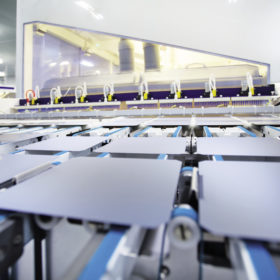
The weekend read: The rise of M6
The shift to the larger M6 wafer format could occur faster than many have expected. Promoted heavily by mono giant Longi, the format is said to be a good fit for both cell and module production, while still allowing for relatively trouble-free integration into PV arrays. And it all began in China.
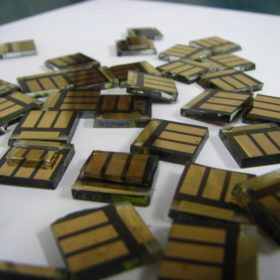
Watch how to improve perovskite solar cells in 2D!
Saudi researchers claim to have improved the thermal stability and moisture resistance of such devices by replacing 3D hybrid perovskite with two-dimensional compounds. They used organic compound ethanolamine, which is said to provide better results in slowing down the hot-carrier cooling process.
New process could yield 26.6% efficient IBC cells
Researchers in Germany are trialing a host of new processes and materials to develop interdigitated back contact solar cells. A deposition technology named ‘hot-wire’ chemical vapor deposition, is said to provide excellent passivation without the need for treatments such as recrystallization or hydrogenation.
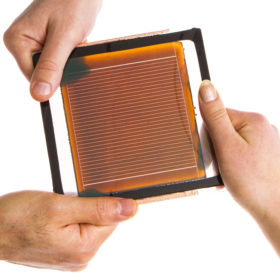
Perovskites meet the stability standard
European research group Solliance says its perovskite modules have passed three key industry standard reliability tests: Light soaking, damp heat and thermal cycling. The group said it is the first time perovskite modules of that size have achieved such results and represents a milestone in the technology’s move toward commercialization.
