
BIPV in Europe: More than just a facade
The renowned PV-Lab at Switzerland’s École Polytechnique Fédérale De Lausanne today announced that it has taken on the role of coordinator for the EU funded research project ‘Be-Smart’, which aims at developing a European industry for building integrated PV components.

Supercomputer scientists dye-ing to test new cell materials
Researchers from the U.S. Department of Energy’s Argonne National Laboratory, working with Cambridge University, programmed a ‘supercomputer’ to narrow down a list of almost 10,000 materials with the potential to be used in dye-sensitized solar cells to just five that fit their parameters for high performance, low cost and low environmental impact.
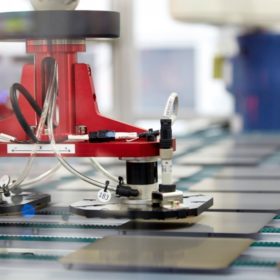
Hanwha Q-Cells sues Jinko, Longi and REC for patent infringement
The Korean solar manufacturer has lodged a patent infringement lawsuit against Jinko and REC in Germany, and two more against the same companies plus Longi in the U.S. Hanwha Q Cells claims its three rivals have used its patented solar cell passivation technology to increase the performance of their products.
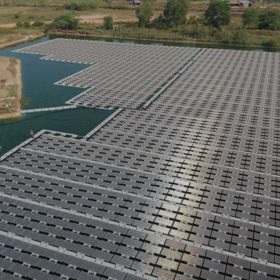
Floating PV offers alternative to grid outages in South Africa
A 60 kW floating array was deployed by New Southern Energy at the reservoir of a fruit farm near Franschhoek, in the Western Cape Province. A second phase of the project will also include storage.
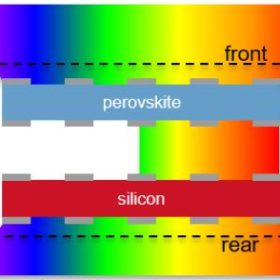
Netherlands’ ECN achieves 30.2% efficiency for bifacial tandem cell based on perovskite
The cell was created by applying a newly developed perovskite cell on top of an industrial bifacial crystalline silicon version. The resulting cell is said to better harvest sunlight, as one unit is optimized for high energy photons and the other absorbs low energy particles.
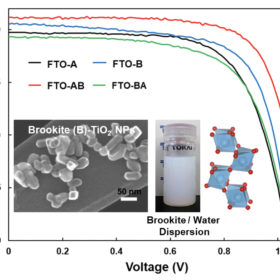
Titanium oxide helps perovskite solar cell reach 16.8% efficiency
A group of Japanese researchers have used anatase and brookite, which are two different variants of titanium dioxide, to improve the efficiency of a perovskite-based solar cell. The use of the two minerals is said to considerably improve the control of the electron transport out of the perovskite layer.
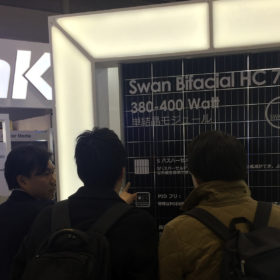
If bifacial panels can compete on price the (backsheet) choice is clear
Jinko Solar has launched a new bifacial solar module, with a clear backsheet manufactured by DuPont, to compete with standard glass-on-glass bifacial products, as well to create markets where bifacial might not have previously fit.

Medium and small power-to-gas conversion already viable
An international team of economists says power-to-gas may already generate hydrogen at costs competitive with fossil fuel power plants in Germany and Texas, provided certain production output levels are not exceeded. If medium and small power-to-gas is competitive, large-scale should be viable by 2030.

ACWA reinforces solar partnership with Huawei and signs Belt and Road deal
The Saudi energy company and Chinese inverter maker and comms firm will team up to use information and communications technology to improve the performance of the former’s PV plants.

Canada appears set for 20 MW power-to-gas facility in 2020
Although light on detail, Hydrogenics Corp’s announcement of an electrolyzer project win appears to signal the North American nation has swelled the number of power-to-gas schemes worldwide – and this one should be in operation next year.
