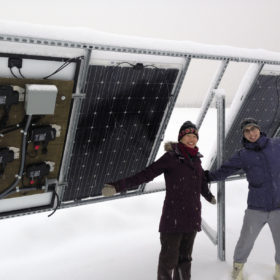
The weekend read: Pursuing a 20% bifacial boost
Research on bifacial solar panel performance has moved performance analysis closer to a standardized practice than ever before. More field tests are underway across the United States, and the first waves of data are expected this year. These tests will help standardize a predictive model for bifacial projects that is bankable.
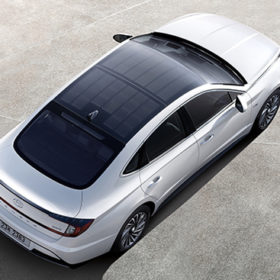
Hyundai enters the solar car race with new Sonata
Hyundai has unveiled its new hybrid, the Hyundai Sonata, complete with integrated solar cells. The Sonata’s unveiling joins Toyota and Lightyear in integrating solar PV with EVs.
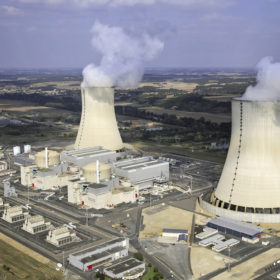
Nuclear: A poor investment strategy for clean energy
Study claims that investment in a new 1GW nuclear power plant leads to average losses of approximately 4.8 billion euros. It further argues that the technology’s dangerous radioactivity emissions and proliferation risks do not qualify it as a ‘clean’ energy solution to be considered for addressing climate change. Yet still, governments are incorporating the technology into clean energy plans around the world.
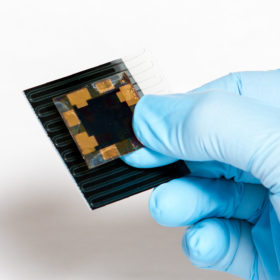
Miasolé hits 20.56% efficiency with flexible CIGS technology
California based Hanergy subsidiary Miasolé has broken its own internal record for thin film cell efficiency, surpassing the 20% mark. The efficiency of 20.56% on a flexible substrate has been confirmed by U.S. National Renewable Energy Laboratory.
One atom layer to ‘free the electrons’
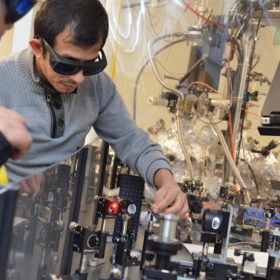
Scientists from the University of Kansas say adding a layer of two-dimensional semiconductor molybdenum disulfide can greatly improve the performance of organic solar cells. The research could also inform efforts to engineer the interface between layers in hybrid organic cells.
Eliminate hydrogen for better battery performance, scientists say
Scientists at the University of California, Santa Barbara who are working with sodium-ion batteries have found that the unintended presence of hydrogen is to blame for many of the technology’s shortcomings in terms of degradation and performance loss. Keeping hydrogen out of the materials throughout production could allow sodium-ion batteries to achieve performance levels competing with their lithium-ion counterparts.

First off-shore PV project launched in the North Sea
A floating solar array will be located in the North Sea near an aquaculture and an offshore wind power facility. The €2 million pilot project is being developed by a consortium including Tractebel, Jan De Nul Group, Deme, Soltech and Ghent University.
Sensing an opportunity for indoor PV
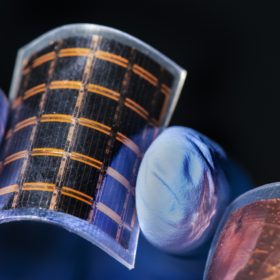
A new paper published by scientists from the Massachusetts Institute of Technology examines the potential for integrating small solar cells into the wireless sensors needed to power the fast-growing internet of things (IoT) ecosystem, many of which are located indoors. This market could represent a unique opportunity for thin film PV technologies, and perovskites in particular, to reduce the risk inherent to ramping up commercial scale production.
Another route to high performance perovskites
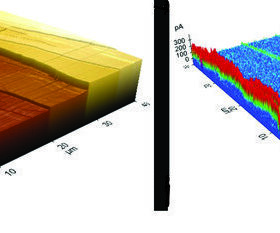
Scientists at Pennsylvania State University have developed a new class of perovskite materials, which they say exhibits unique properties that could have several implications for the development of perovskite solar cells, as well as other electronic applications.

Scientists set new efficiency record for single crystal perovskite
Scientists at Saudi Arabia’s King Abdullah University of Science Technology have set a new efficiency record of 21.09% for a single crystal perovskite. The researchers say this highlights a place for the technology to develop alongside the multicrystalline versions which are progressing toward commercialization.
