
Building resilient grids with battery storage
As part of a special edition produced for the Genera exhibition in Madrid, pv magazine publisher Eckhart K. Gouras examines the different trajectories battery storage deployment has taken in the United Kingdom and Spain, and the implications for grid stability.

Powering flexibility
Once limited to pilot-scale demonstrations, battery storage is emerging as a core feature of national power strategies across the Middle East and North Africa (MENA) region. Governments that once regarded batteries as experimental add-ons to solar projects are now offering gigawatt-hour capacities and incorporating storage into long-term planning.

Syrian solar: From luxury to lifeline
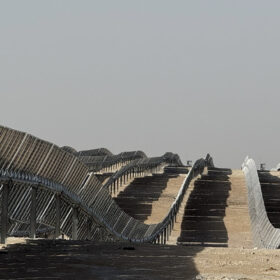
Regime change has reshaped Syria since the collapse of the Assad government in December 2024, but the country’s grid remains fragile. Daily electricity supply, even in the capital Damascus, still averages around one hour on, five hours off. It’s a pattern that has turned solar power into a necessity, writes Tristan Rayner.
MENA’s next move
Solar power across the Middle East and North Africa (MENA) region is expanding at an unprecedented rate. Insights from the Middle East Solar Industry Association (MESIA) Solar Outlook Report 2025, based on data from Rystad Energy, show that the region’s installed solar capacity reached about 24 GW (AC) in 2024, marking a 25% increase from the previous year. Asma’u Umar, research intern at MESIA, notes that much of this growth has been driven by Saudi Arabia, the United Arab Emirates, and Egypt, where abundant sunlight and open desert land are turning the region into a global hub for solar power and energy diversification.

Forecasting big things
The output of a solar power plant is as unpredictable as the weather. Utilities and other stakeholders require forecasting on timeframes of between three days and 30 minutes ahead to optimize operations and ensure grid reliability. Reuniwatt’s Hannah Bergler reveals the complexity of providing forecasts at a PV mega project in the United Arab Emirates.

Solar anywhere
From the quiet plains of Alsace to some of the planet’s harshest frontiers, French company Ecosun Innovations is shipping out plug-and-play solar containers to bring instant, reliable power to off-grid sites. What began as a solution for construction crews and humanitarian missions is now attracting the attention of a new, fast-growing customer: the world’s armed forces, hungry for energy independence and low-carbon field operations.
Solar shines through Mali’s diesel drought
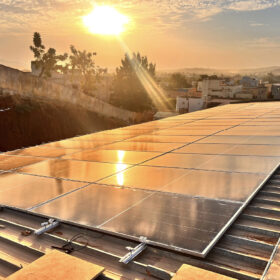
France-based commercial solar specialist Tysilio recently installed three hybrid solar-plus-storage projects in Bamako, Mali. pv magazine spoke with Xavier Juin von Juterzenka, the company’s co-founder, CEO and international business director, about how these installations have helped customers continue to operate while a severe fuel shortage causes heavy disruptions nationwide.
From scrapheap to strategy
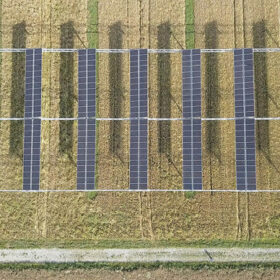
As many PV plants approach the midpoint in their typical lifespan of 25 to 35 years, the industry faces crucial decisions about what comes next. Much of the focus so far has been on managing modules, particularly on recovering their silicon and other materials. But the conversation must also extend to mounting structures. As the backbone of all solar plants, these structures represent a significant share of material use and a plant’s embodied carbon footprint. Everoze’s Kuba Gajewski explores reuse and end-of-life strategies for these structures and the practical barriers impeding their implementation.

Projects: The grid of the future
Major obstacles to further solar deployment are tackled by this year’s winner, an energy storage project that provides the kind of grid-shoring support that will be vital in global markets before long. From synthetic inertia to software-informed module cleaning, the pv magazine Awards Projects jury has rewarded those that have used technological innovation to achieve world firsts and significant cost savings.

Modules: Pushing to the efficiency summit
Selecting a winner from this year’s crop of modules was a difficult task. Perovskite-silicon tandem products were on the shortlist for the first time, provoking serious discussion, but questions remain over the market readiness of this technology. Several entries exemplified the industry’s impressive progress with tunnel oxide passivated contact (TOPCon) technology, including new milestones in efficiency, bifacial performance, and overall power rating. Ultimately, the jurors chose a winner that is treading a different technology pathway, the one most likely to bring single-junction silicon solar to its practical performance limits.
