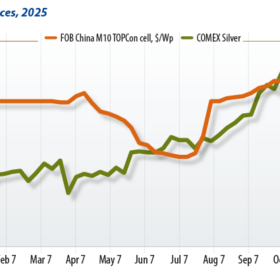
Consolidation mode
Policy developments, or the lack thereof, continue to shape market sentiment along the solar supply chain. Hanwei Wu of OPIS sees growing likelihood that China will implement a rumored plan to purchase and shut down excess polysilicon capacity, but slow progress keeps prices in a holding pattern.

Modules: Pushing to the efficiency summit
Selecting a winner from this year’s crop of modules was a difficult task. Perovskite-silicon tandem products were on the shortlist for the first time, provoking serious discussion, but questions remain over the market readiness of this technology. Several entries exemplified the industry’s impressive progress with tunnel oxide passivated contact (TOPCon) technology, including new milestones in efficiency, bifacial performance, and overall power rating. Ultimately, the jurors chose a winner that is treading a different technology pathway, the one most likely to bring single-junction silicon solar to its practical performance limits.
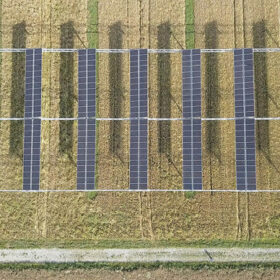
From scrapheap to strategy
As many PV plants approach the midpoint in their typical lifespan of 25 to 35 years, the industry faces crucial decisions about what comes next. Much of the focus so far has been on managing modules, particularly on recovering their silicon and other materials. But the conversation must also extend to mounting structures. As the backbone of all solar plants, these structures represent a significant share of material use and a plant’s embodied carbon footprint. Everoze’s Kuba Gajewski explores reuse and end-of-life strategies for these structures and the practical barriers impeding their implementation.

Projects: The grid of the future
Major obstacles to further solar deployment are tackled by this year’s winner, an energy storage project that provides the kind of grid-shoring support that will be vital in global markets before long. From synthetic inertia to software-informed module cleaning, the pv magazine Awards Projects jury has rewarded those that have used technological innovation to achieve world firsts and significant cost savings.

Building competitive battery manufacturing in India
India must prioritize a policy framework that integrates the entire value chain, from raw materials and recycling to cell manufacturing and deployment, if it is to ensure long-term resilience for its battery manufacturing sector. That was the view of pv magazine Insight session panelists at The Battery Show, held alongside the Renewable Energy India Expo 2025 in Greater Noida, India, as Uma Gupta reports.

Final thought: Navigating growth amid structural challenges
Spain’s solar industry stands at a critical juncture. After years of remarkable expansion, the sector faces a complex landscape, where past successes have paradoxically created new obstacles that demand urgent solutions.
On the road with pv magazine
Key events for pv magazine in November and December 2025.

Building investor confidence with ESG
Gathering robust environmental, social and governance (ESG) data and using it to implement effective company policy is far more than a box-ticking exercise. Everoze Partner Ellie van der Heijden sees its growing influence as a strategic differentiator for the renewable energy industry. Projects that embed ESG thinking from the outset build investor confidence and navigate regulatory and reputational risks with agility.
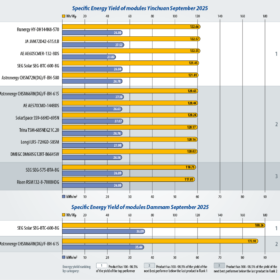
pv magazine test: September 2025 results
George Touloupas, vice president of ESG and new services at Intertek CEA, and Huatian Xu, director of technology and quality, analyze the September 2025 results from the pv magazine test outdoor installations in Yinchuan, China, and Dammam, Saudi Arabia.
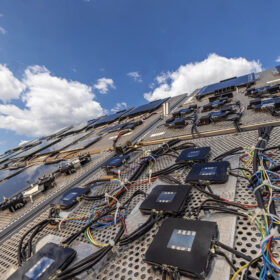
Let’s go outside
With impressive and still improving efficiency results, perovskites have caught the solar industry’s attention in recent years. Most market observers now forecast widespread commercial use of the material group in solar cells beginning in the early 2030s, but there’s still a lot of work to do for that to become reality.
