
Brace for impact
Worldwide, the solar industry has taken a few knocks in 2025. Oversupply has seen PV manufacturers continue to rack up billions in losses, and support for a rapid transition away from fossil fuels has wavered in several key regions.
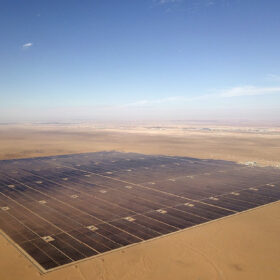
From standards to sandstorms
The Middle East now ranks among the world’s most ambitious solar markets. Gigawatt-scale projects across Saudi Arabia, the United Arab Emirates, and Egypt are supported by national programs that pair large tenders with local-content incentives aimed at onshoring production. Yet the same geography that powers the region’s solar boom challenges developers in unique ways, write Intertek CEA experts Jörg Althaus and Huatian Xu.

The pv magazine Awards 2025
In a year that has posed challenges for the solar industry, the 2025 crop of pv magazine Award entrants presented our expert jurors with a vision of what the future might hold. From world-first technologies supporting grid stability to second-life solutions that bolster sustainability, along with activism in rapidly growing PV markets and innovations for emerging market segments, technical progress is driving the energy transition. The time has come to reveal the pv magazine Awards 2025 winners.

Sustainability: Sharing the knowledge
This year, our jury panel chose two education-focused entries as their winner and highly commended picks, acknowledging the impact of getting the right information to the right people at the right time. Sustainability can be taken for granted as an in-built value of the energy transition, but in reality it continues to need champions willing to make practical and quality information accessible where it is most needed.

Building resilient grids with battery storage
As part of a special edition produced for the Genera exhibition in Madrid, pv magazine publisher Eckhart K. Gouras examines the different trajectories battery storage deployment has taken in the United Kingdom and Spain, and the implications for grid stability.

The road to higher kesterite efficiencies
Researchers pushed kesterite thin-film solar cells to a record-certified efficiency of 14.2% in 2024, and have now reached a new module record of 13%. But achieving 20% or higher, which could drive broader commercial interest, remains a distant goal, reports pv magazine’s Lior Kahana.

Manufacturing: Sustainable innovation
Despite difficult market conditions for many in the sector, solar manufacturers and technology suppliers have continued to innovate in 2025. This year’s winner reflects the emergence of PV recycling as a manufacturing and technology sector in its own right, while the highly commended entry provides a great example of equipment suppliers’ ability to quickly adapt to changes in cell technology and the new requirements they bring.

Syrian solar: From luxury to lifeline
Regime change has reshaped Syria since the collapse of the Assad government in December 2024, but the country’s grid remains fragile. Daily electricity supply, even in the capital Damascus, still averages around one hour on, five hours off. It’s a pattern that has turned solar power into a necessity, writes Tristan Rayner.

Inverters: Fully SiC design takes the win
The jury of the pv magazine Awards 2025 once again faced a challenging comparison. Submissions spanned the full inverter spectrum, from microinverters for balcony systems to multi-megawatt central units for grid-scale storage. The diversity of technologies underlines how dynamic the inverter segment remains and how difficult it is to evaluate across this spectrum. Facing the challenge, the jury awarded first place to a product dedicated to the fast-growing grid-scale battery storage market – an offering that also aims to open opportunities in new market fields. Second place similarly went to a grid-scale design that reduces servicing costs in this segment.

What makes batteries cheaper?
The Cheaper Home Batteries Program came into effect on July 1. The AUD 2.3 billion ($1.5 billion) policy offers a discount of up to 30% on upfront residential battery cost in its first year, delivered through the existing Small-scale Renewable Energy Scheme (SRES) – the same program that has subsidized sub-100 kW solar systems in Australia since 2001.
