
Green ammonia breakthrough a potential boon for solar-powered exports
Scientists from the University of New South Wales and the University of Sydney have made a breakthrough in the development of green ammonia. Their findings could alter the global industry with the help of solar to produce green ammonia for export to countries like Japan and Germany, instead of straight hydrogen.

Biden recommits US to Paris climate accord, blocks Keystone pipeline
One environmental group said the new president’s actions make “the United States once more part of the global climate solution – not the problem.”
Beijing: China installed 48.2 GW of solar in 2020
With the nation almost doubling its new generation capacity figure for the year last month, the National Energy Administration is reportedly considering a joint solar and wind capacity target of 120 GW for this year.
Jenny Chase predicts up to 194 GW of solar this year
Falling module prices will help PV post another record year after an estimated 132 GW was installed worldwide in 2020, according to an energy transition investment trends report published by Bloomberg New Energy Finance.
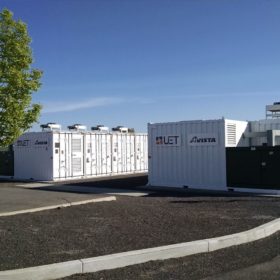
The best redox flow battery tech
Batteries based on vanadium or zinc bromide represent the cutting edge of redox flow storage tech, an international research team has claimed. They have identified challenges and opportunities for about a dozen redox flow storage technologies, while providing estimates of their current and projected levelized costs of storage.
Solar offers multiple options to manganese mine in Botswana
Canada-based Giyani Metals is planning to build a solar plant for its manganese mining site in Botswana. Three kinds of projects, with capacities ranging from 14 to 60 MW, are being considered. The power generated by the facility may be either consumed entirely by the mine or also sold to the grid under different scenarios.
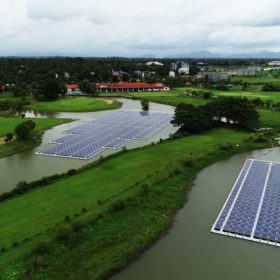
Floating solar plant online at Indian airport
The 452 kWp array features 1,300 photovoltaic panels across an acre of water split between two artificial lakes at the airport golf course.
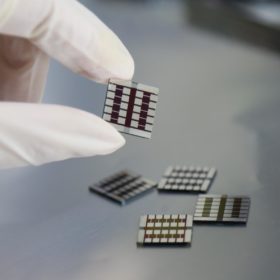
A pinch of chili gives perovskites a kick
Scientists in China found that capsaicin, the natural compound responsible for a chili pepper’s spicy flavor, can also act as a ‘secret ingredient’ in perovskite solar cells, making them both more efficient and stable. The group added capsaicin to the precursor materials of a common perovskite, leading to dramatic improvements in the resulting solar cell.

Tidal flats in eastern China to host 300 MW of solar
Developers have already connected 3 MW of capacity in what is purportedly destined to be the world’s largest PV array on a coastal tidal flat. The project, which is particularly challenging due to tidal fluctuations, will feature PV components designed to cope with salt and water damage.
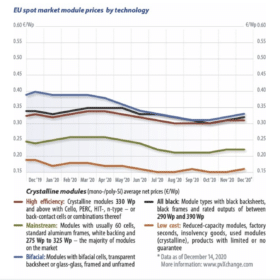
Module Price Index: 2020 – Taking the time to say ‘thanks’…
Alongside all of the problems, 2020 has brought us a few promising solar module manufacturer initiatives and developments. Martin Schachinger of pvXchange.com looks back over the second half of the year and offers a quick look at what could be in store for 2021.
