
EnergyTrend expects price shuffle after EU ends MIP
According to the Taiwanese analysts, the solar PV module market is still stable. However, EnergyTrend expects a new price war to erupt with the end of minimum import tariffs (MIPs). In particular, Taiwanese manufacturers will have to cope with increasing price pressure.

EU officially ends MIP for Chinese solar imports
In an unexpectedly early announcement, the European Commission has decided to end EU anti-dumping and anti-subsidy measures on solar PV cells and modules from China at midnight on September 3.
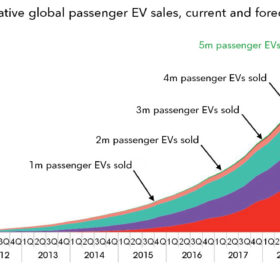
Global EV sales hit 4 million, soaring market sees next million in May 2019
While it took 60 months to reach the first million electric vehicle (EV) sales, in late 2015, it took the fourth million just six months. China is driving this development. Meanwhile, as first generation EVs batteries are reaching their end-of-life, interest in second-life use cases is growing. The volume of retired EV battery packs is set to be 108 GWh by 2029 – representing a third of the expected storage capacity market at that time.
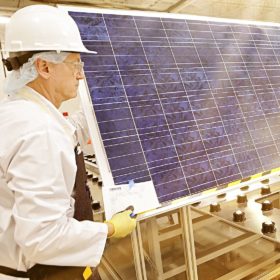
Lion Point Capital offers $250m to support Canadian Solar’s go-private bid
Shares of Canadian Solar soared earlier this week after U.S. investment firm Lion Point Capital revealed that it had initiated discussions with a number of undisclosed third parties about the possibility of funding the privatization of the solar PV module supplier.
Undaunted Xinyi presses on with production expansion
Chinese solar glass manufacturer will forge ahead with plans for three new Malaysian fabs – at some point – but EPC and development operations are fading into the shadows in the wake of Beijing’s new PV policy direction.

China files section 201, 301 WTO complaints against US
China has officially filed two complaints with the World Trade Organisation (WTO) against the United States, in response to its 30% Section 201 and 25% Section 301 tariffs.

Is China about to add 10 GW of unsubsidized solar?
Rumor has it industry lobbying has persuaded the government to agree to 300-500 MW of distributed PV in each of the populous nation’s 34 local government areas, with a reduction in “non-technical costs” making up for a lack of guaranteed payment.
Solargiga expects $15 million loss on back of China’s PV policy changes
Solargiga Energy Holdings Limited has issued a profit warning, stating it expects to record a loss of around US$15.2 million for the period ending June 30, 2018.

Funding the key obstacle to renewables in Asia
Banks categorize renewable energy projects as risky and believe they offer lower rates of return than fossil fuel schemes, making them reluctant lenders.

Trony shares to be wiped from exchange on Thursday
Drawn-out business of the removal of the thin-film manufacturer’s stock from the Hong Kong exchange is almost at an end. Trading in the Shenzhen-based company’s shares has been suspended for more than six years.
