
Croatia to invest €40 million in household solar, batteries, heat pumps
The Croatian government’s latest set of energy support measures includes new financing for residential solar, batteries and heat pumps, expected to support up to 15,000 applications, as well as an extension of existing electricity price subsidies for homeowners.

The prospects for ultra-high-temperature heat pumps
An international research team has reviewed emerging solid-state and gas-cycle heat pumps capable of reaching temperatures of up to 1,600 K, assessing their challenges, applications, scalability, and technology readiness levels. The researchers say these systems could outperform conventional high-temperature heating technologies by achieving coefficients of performance above 1.

Croatia deploys 417 MW of solar in 2025
Croatia’s solar capacity is on course to exceed its wind energy capacity for the first time in early 2026. With utility-scale projects facing regulatory deadlock and the end of net-metering for the residential market, growth is being led by commercial and industrial customers.
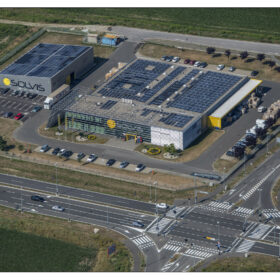
Croatia’s regulatory deadlock is strangling large-scale solar
Regulatory inaction on grid fees has stalled 3.5 GW of large-scale renewables in Croatia, mostly solar, with developers such as Solvis citing a lack of stable grid-connection rules as a barrier to planning and investment.
Croatia’s solar capacity reaches 1.1 GW
Croatia’s solar market continues to grow steadily, led by the self-supply and commercial and industrial (C&I) segments, while regulatory barriers stall utility-scale development.
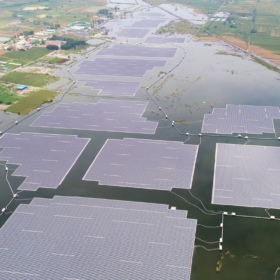
Water-based photovoltaics reach global capacity of 21.18 GW
An international research team has developed an index-based remote sensing method to see trends in the global development of water-based PV. It has found that China currently accounts for 80% of the global total deployed capacity.

Croatia reaches 1 GW solar milestone
Croatia’s renewable energy association says the country has now deployed more than 1 GW of solar. Speaking at the site of an ongoing 99 MW project development, Prime Minister Andrej Plenković said the green energy transition is one of the government’s four strategic goals.

Low residential solar feed-in tariffs can encourage battery deployment
Analysis of feed-in tariff scenarios in Central and Eastern Europe finds that while high feed-in tariffs are linked to the adoption of residential solar, lower tariffs are more likely to encourage battery installations. The study proposes a moderately low range of tariffs as one compromise to support both technologies.

Axpo signs 10-year corporate PPA in Croatia
Swiss power producer Axpo has signed a 10-year corporate power purchase agreement (cPPA) to supply 17.5 GWh of electricity to two production sites of Croatian HVAC manufacturer Klimaoprema.
Croatia’s new solar additions hit 397.1 MW in 2024
The Renewable Energy Sources of Croatia Association (RES Croatia) says Croatia’s solar market is growing year over year. But with residential and industrial rooftops accounting for most new installations, a key focus is enabling utility-scale growth.
