
Jabil closes 700 MW solar module factory in Poland
The company, which was one of Europe’s largest OEM module manufacturers, has decided to close its Polish manufacturing facility, due to an expected drop in demand.

Ukraine’s renewable energy outlook under the new electricity market design
Svitlana Teush, counsel at Redcliffe Partners law firm in Kyiv, Ukraine, discusses the country’s new electricity market design and what it means for renewables. Currently, she says, the renewable energy sector in Ukraine is an attractive investment prospect and has considerable potential for further growth in the coming years.
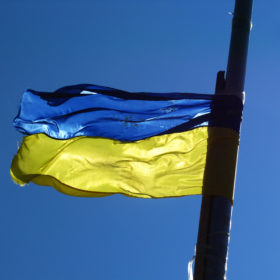
Ukraine added 211 MW of solar in 2017
The country’s cumulative installed solar power has reached 741 MW, while rooftop PV under net metering has topped 37 MW. Over 500 MW of new PV additions are expected in 2018.

Russian companies plan vertically-integrated monocrystalline module factory
The manufacturing facility is planned to be built in Russia’s Astrakhan region thanks to an investment of 1.5 billion RUB (around US$26.5 million).
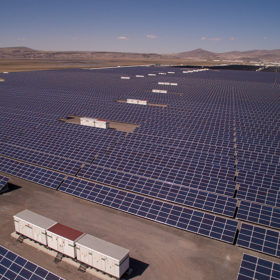
Europe added 8.61 GW of solar in 2017 with Turkey taking top spot
Annual growth of 28% on 2016’s performance points to promising future as Turkey’s 1.79 GW saw the nation overtake Germany as Europe’s most dynamic solar market. Former shining star, the U.K. slinks away from top table after shrinking 54%.
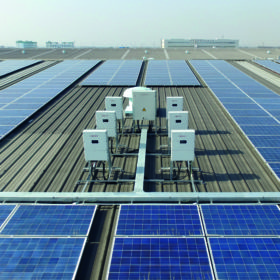
Energy Community Secretariat issues policy guidelines for eastern European prosumers
The international organization, which aims to extend the good practices of the EU’s internal energy market to southeastern Europe and the Black Sea region, has released new guidelines for the grid integration of distributed generation power generators.
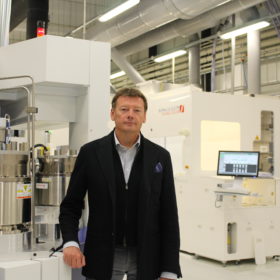
Solitek to expand cell and module capacity
The Lithuania-based manufacturer aims to increase cell capacity at its factory in Vilnius from 80 MW to 180 MW, and to open a new 60 MW module assembly factory in the Ukraine.
EU, China request consultation with US over solar tariffs, WTO filing shows
Following the introduction of 30% graduated tariffs on imported solar modules into the U.S., the European Union and China have joined South Korea and Taiwan in filing a complaint with the World Trade Organization.

EU approves capacity mechanisms for Belgium, France, Germany, Greece, Italy and Poland
The European Commission stated that capacity mechanisms in these five electricity markets are in line with EU state aid rules, and that all of the mechanisms are “well-designed”. SolarPower Europe says further supporting most polluting power generation forms through capacity mechanism simply does not make sense anymore.
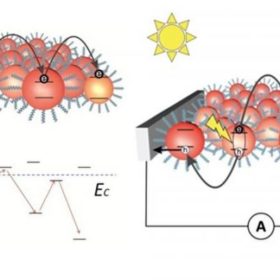
Russian scientists investigate quantum dot solids for PV applications
Researchers at the Moscow Engineering Physics Institute (MEPhI) have developed next-generation solids consisting of quantum dots (QD), or semiconductor crystals with a diameter of just few nanometers, that could deliver a big step towards cheaper and more efficient photovoltaic devices.
