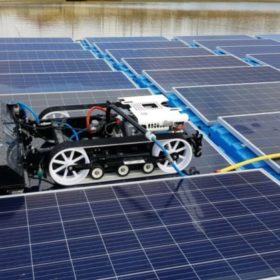
Cleaning robot for floating PV
A cleaning robot optimized for floating PV installations was developed by German manufacturer TG hyLIFT. Also suitable for ground-mount PV, it uses only water without any type of detergent, and is powered by batteries. The robot is now being tested at a floating PV array in Spain.
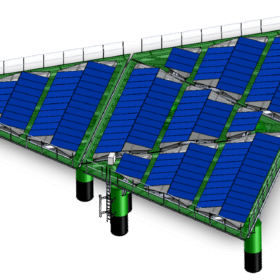
Dutch startup develops offshore floating PV platform
Dutch startup SolarDuck has developed a triangular structure for floating PV that resembles an offshore oil platform. CEO Koen Burgers told pv magazine that it keeps panels more than 3 meters above the water surface, and claimed that the structure can handle waves and dynamic loads. It will be used in a Dutch pilot project from April.

Spain joins the gigafactory race
SEAT and Iberdrola are planning to build an EV battery manufacturing facility in Barcelona with the support of the Spanish government.
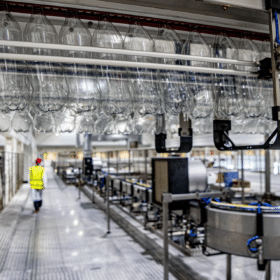
Zero carbs diet for Coca-Cola in the Netherlands
Dutch power utility Eneco will supply solar and wind power from projects in front of the factory gates to allow the beverage factory to decarbonize its production.
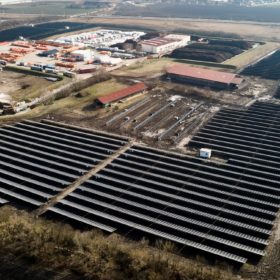
Austria’s largest PV plant comes online
The 11.5 MW solar park is operated by Austrian power provider Wien Energie. The plant includes sheep farming.
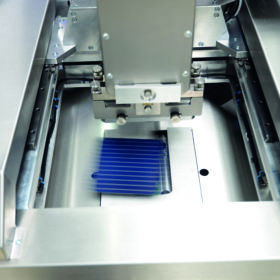
Simulating PV’s silver future
Scientists at Germany’s Fraunhofer ISE developed a model to simulate different setups for screen printing in solar cell metallization. The model provides a comparable ‘screen utility index’ value that can predict the usefulness of different architectures in the printing equipment in relation to the properties of a given silver paste. The approach, says Fraunhofer, will assist the PV industry in reducing the amounts of silver needed in silicon cell manufacturing.

Guessing game with 1,550 PV outcome scenarios
Swiss scientists have analyzed scenarios to predict the role of PV in the global energy mix by 2050 and have found that European entities expect a sharply higher compound annual growth rate than their Asian and North American counterparts. They also noted that the growth scenarios of the Intergovernmental Panel on Climate Change are more conservative than other predictions.
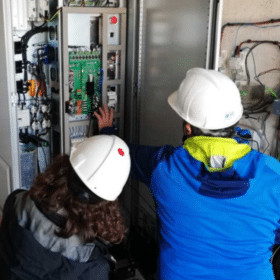
New power electronic device to manage surplus solar power
The device was developed by an international consortium through the EU-funded project Renewable penetration levered by Efficient Low Voltage Distribution grids (RESOLVD). The power electronic technology is claimed to be able to combine different storage technologies in a single electronic-based board interface.

Avancis claims 19.64% efficiency for CIGS module
The German manufacturer said the result was confirmed by the US National Renewable Energy Laboratory. The achieved efficiency is claimed to be a world record for a CIGS panel with an integrated series connection of 30×30 cm.
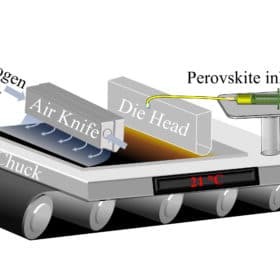
Slot die coating for 20.83% efficient perovskite thin-film solar cell
Scientists in Germany demonstrated a slot die coating process for large-scale production of perovskite thin-film solar cells that achieved a maximum efficiency of 20.83%. Using an additive, and experimenting to find the optimal concentration, the group demonstrated improved control over the crystallization process – crucial for developing stable, repeatable processing.
