
Russia to tender 500 MW of solar in 2021
The country’s cumulative installed PV capacity reached 1.7 GW at the end of 2019, as a result of the grid-connected projects tendered by the Russian government between 2014 and 2019. The remaining 500 MW quota of the 2.2 GW tendering scheme should be assigned this year.

Romania improves rebate scheme to speed up rooftop PV development
The Romanian government has changed the rules of the Casa Verde Fotovoltaice (green PV home) scheme to support residential solar installations under the country’s net metering regime. The new provisions improve the installation process and settlement of rebate payments.

UK government asks how future renewables incentives should work
The success of unsubsidized clean power facilities in the country – whether driven by corporate power purchase agreements or selling direct to the wholesale electricity market – has prompted the Department for Business, Energy and Industrial Strategy to ponder whether contracts-for-difference payments will be fit for purpose in the years ahead.
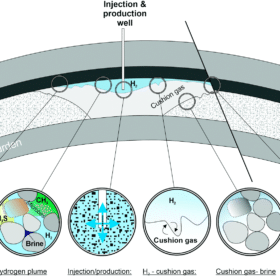
Key challenges for underground hydrogen storage
An international research team has presented challenges and knowledge gaps in the implementation of large scale underground storage of hydrogen. The main issues associated with this technology relate to the fluid flow behavior of hydrogen in subsurface reservoirs, geochemical reactions caused by hydrogen injection, biotic reactions caused by excess hydrogen, and the geomechanical response of the subsurface to hydrogen storage.
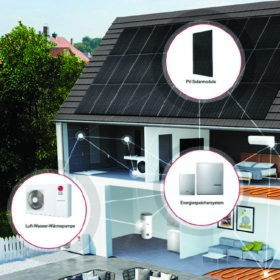
LG Electronics offers hybrid system combining heat pump, PV and storage
The system generates electricity and heat for residential houses and small businesses. An integrated energy management system should guarantee maximum self-consumption of the solar power produced.

EDF begins work on 20 MW floating PV plant in France
The French energy company will build the facility on the water reservoir of the Lazer hydroelectric plant, to double its production. Construction is expected to require 13 months.
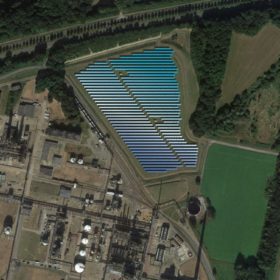
European joint venture wants to deploy 4 GW of PPA-linked solar across UK, Germany and the Netherlands
Ampyr Solar Europe, a new joint venture between Naga Solar, the AGP Group, and Hartree Partners, will develop ground-mounted photovoltaic projects in the three European countries. The solar parks will be financed through power purchase agreements with energy suppliers and businesses.
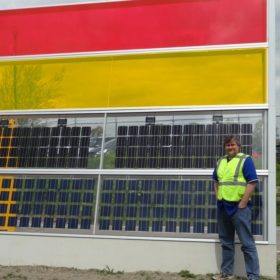
Improving PV panel performance with luminescent solar concentrators
Researchers in the Netherlands say the lack of a universal standard is preventing luminescent solar concentrators from being widely adopted as photonic devices or for improvement of PV module performance. This technology can be integrated with finished solar panels with no need of modifying their electronic structure, helping them collect high-energy photons that they fail to harvest.

Enel Green Power’s new CEO speaks up about auction prices, module manufacturing and green hydrogen
In a recent media brief, new Enel Green Power CEO Salvatore Bernabei discussed the company’s operating results for 2020 and its future strategies across several markets. pv magazine asked him questions about new solar plans, recent auction prices and the PV module factory the Italian group operates in Catania, in southern Italy. Bernabei also made it clear that he wants to bet on green and not blue or grey hydrogen for the company’s next step into the energy transition.
Risk vs. reward: Optimizing energy yield with 182mm wafers
The shift to larger wafer formats has been by far the most important trend in the PV supply chain over the past year. While other sizes are also being introduced to the market, the 182mm product is initially expected to represent the largest share. And it is viewed by many as the optimal way to ensure considerable gains in energy yield whist minimizing disruption to supply chain and end markets. We’ll delve into these claims surrounding modules based on the 182mm wafer, taking a closer look at Jinko’s Tiger pro module series.
