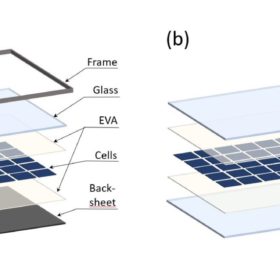
Frameless glass-glass solar modules made in Europe have the best CO2 footprint, Fraunhofer ISE says
The German research institute has compared the CO2 emissions of glass-glass and glass-backsheet solar modules manufactured in Germany, the EU and China, and found glass-glass modules enable an additional emissions reduction ranging between 7.5 to 12.5% compared to PV modules with backsheet film, regardless of the location.
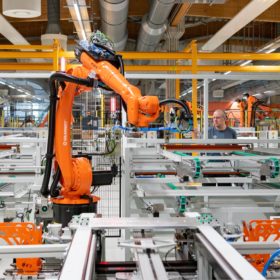
Solarwatt brings new module and battery factories online in Germany
German manufacturer Solarwatt today announced the opening of a new 300 MW module production facility, as well as new battery pack assembly lines, located on the outskirts of Dresden. The company invested around €35 million in the new lines and says it will begin delivering modules produced on the new equipment to customers as early as next week.
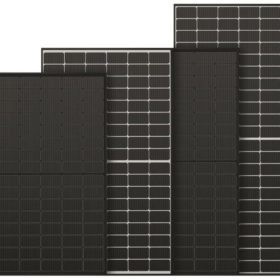
Sonnenstromfabrik launches new PV module series with large wafers and power of up to 490 W
The German solar manufacturer has unveiled three new formats for its glass-film and glass-glass PV modules for the first quarter of 2022.
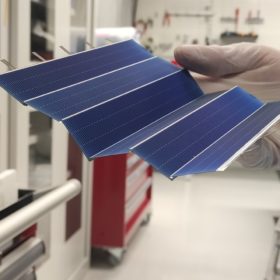
Fraunhofer ISE develops solder-free aluminum interconnection tech for shingled PV modules
The German research institute has unveiled a novel interconnection technology for shingled PV modules that eliminates the need for electrically conductive adhesives and screen-printed busbars. It consists of an 8-μm-thick aluminum foil that is joined to the silicon nitride (SiNX) passivation via laser metal bond (LMB). When integrated in a solar module, the efficiency of the new interconnector improved by 0.7%.

The Hydrogen Stream: Indian group makes bold green hydrogen claim as plans emerge for production capacity in Spain
The renewables-powered sustainable hydrogen announcements have come as a group of international researchers made controversial claims about the potential of gas-fired blue hydrogen to be part of the climate change solution.
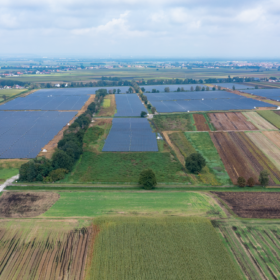
Anumar switches on southern Germany’s largest solar park
The 120 MW solar plant will sell power under two long-term PPAs for the electricity to be generated by 90 MW of its capacity.

Agrivoltaics to protect crops from heavy rainfall
BayWa r.e. and the Fraunhofer Institute for Solar Energy Systems ISE have built a 258 kW agrivoltaic system that hosts apple cultivation under four different crop protection systems. The system utilizes agrivoltaic technology with permanent, light-permeable PV modules that block rain, and tracking PV module tech that blocks rain only if necessary.
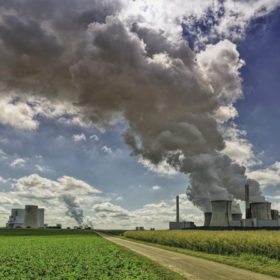
China holds the key to cancelling half the world’s new coal project plans
With pressure mounting on the world’s governments to turn their back on the fossil fuel, China and peers in South East Asia, Europe and South Asia could help deliver a coal-free future at the COP26 climate summit planned in Glasgow in November.
Commission flags up €875m renewables project fund
A call for grant proposals has been promised this month, with the bloc’s executive yesterday firing the gun on a separate exercise related to cross-border EU energy infrastructure projects.
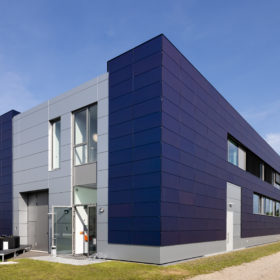
Solar facade with frameless design
The frameless design of the 50 kW facade was made possible by a concealed suspension technology that, according to its creators, eliminates the need for additional edging at the edge of the module. The installation was built with 135 W CIGS solar modules.
