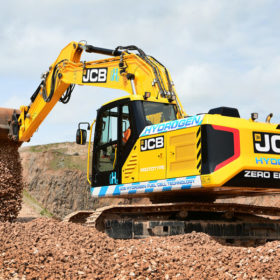
The Hydrogen Stream: Rolls Royce, rising prices, and hydrogen fueled beer
This week sees hydrogen pricing hit new highs, driven by simultaneous jumps in the price of natural gas and electricity. Elsewhere, project plans include green hydrogen production at a UK brewery and Ineos building a 100 MW electrolyzer in Germany, machinery manufacturers Rolls Royce and JCB making plans for hydrogen engines, and new investment agreements signed in Belgium, Sweden and Kazakhstan.
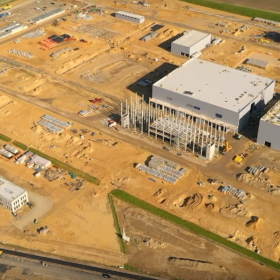
Umicore to purchase 42,000 tons of lithium battery material
Belgian materials company Umicore has signed a contract with Australia headquartered Vulcan Energy Resources to purchase up to 42,000 tons of lithium hydroxide over a five year period beginning in 2025. The material will be used in Umicore’s production of cathode materials for lithium-ion cell manufacturers.

Co-located hubs key to battery industry competitiveness
A report from Australia’s Future Battery Industries Cooperative Research Centre which analysed the development of battery hubs in the U.S., Germany and Japan, has found that co-location and cooperation between industry and government were key to their success. For Australia to play the same game, it will have to leverage its wealth of resources, and clean up its act along the way.
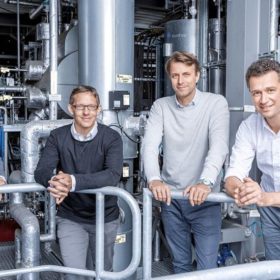
Sunfire secures €109 million investment to accelerate green hydrogen technology growth
The leading industrial electrolyzer maker is planning to expand its alkaline electrolysis business with the construction of a large-scale production site in Germany that will have an annual manufacturing capacity of 500 MW by 2023, with a further extension to gigawatt-scale already in the planning.
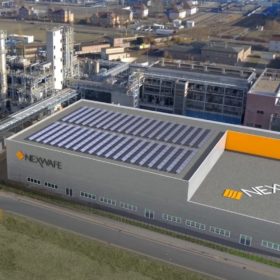
Reliance Industries to invest $29 million in Nexwafe
Reliance New Energy Solar, a subsidiary of Reliance Industries led by billionaire Mukesh Ambani, which is planning a huge manufacturing venture in Gujarat, India, has led a series C financing round in German wafer manufacturer NexWafe with an investment of EUR 25 million ($29 million). This marks the third major investment in renewables announced by the Indian multinational this week.
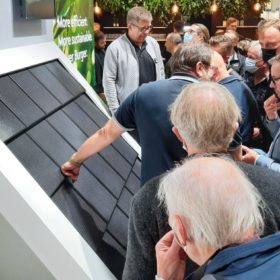
Meyer Burger unveils new solar tiles
Meyer Burger plans to start selling a new building-integrated PV product from 2022. It says the solar tiles have a high energy yield, with simplified installation and the ability to also provide heating. German engineering company paXos designed the tiles.
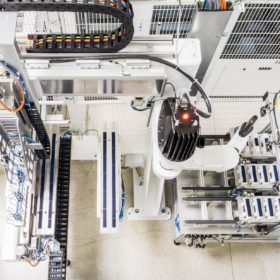
New ‘matrix’ layout for shingled solar cells
German equipment supplier M10 and research institute Fraunhofer ISE will unveil a new prototype stringer for shingled module layouts at the Intersolar Europe trade show later this week. Employing an offset layout for the shingles, the approach promises a relative efficiency gain of up to 6%, compared to a conventional half-cell module.
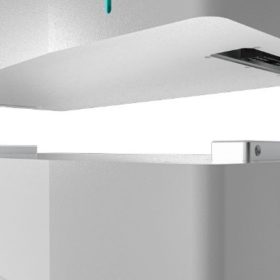
M-Tec launches modular battery with integrated hybrid inverter
The modular battery can be cascaded up to 30.7 kWh of storage capacity. The Energy Butler is a storage kit made up of up to eight modules.
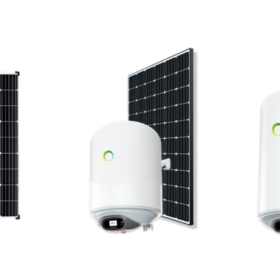
Photovoltaic-plus-boiler solution from Germany
The photovoltaic boiler can be easily be installed by the users themselves. The solar modules are connected to the boiler via an MC4 contact plug, and heat the water.
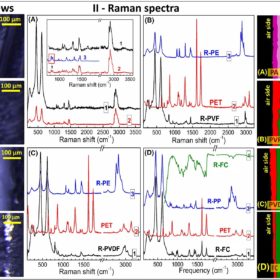
Monitoring near-infrared transmission for a healthy backsheet
Scientists in Germany developed a method to determine the structure and degradation of module backsheets and encapsulants in the field, by analyzing the material’s near infrared light transmission. Applying the theory to a multi-MW PV plant, the group was able to identify four different backsheet types. With further development, the method could be a valuable tool to monitor module degradation in the field and spot faults early on.
