
U.S government sets preliminary countervailing duties on solar imports from India, Indonesia and Laos
The U.S. Department of Commerce has issued preliminary findings that solar manufacturers in India, Indonesia and Laos benefited from government subsidies, paving the way for countervailing duties of up to 143.30%.
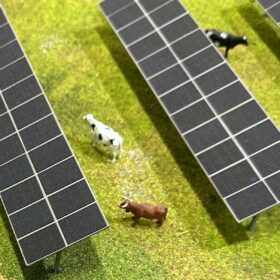
The impact of agrivoltaics on soil properties
New research shows how agrivoltaic systems can reshape soil by altering moisture, temperature, and microbial activity, creating heterogeneous zones under and between panels. Proper design and management can boost soil health and crop resilience, especially in degraded or arid regions, though long-term effects remain uncertain.

Indonesia’s solar capacity reaches 1.49 GW
Indonesia surpassed 1 GW of cumulative solar capacity in 2025, with an estimated 546 MW of added solar last year, led by deployments in the rooftop C&I segment.
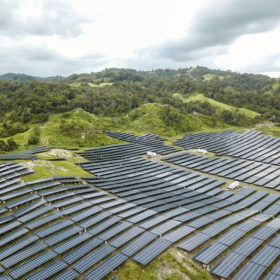
Grid code standards key to unlock Indonesia’s solar potential
New research shows how modern technical standards, combined with broader regulatory and grid reforms, are essential to ensure system reliability in the Indonesian electricity system as renewable capacity grows.
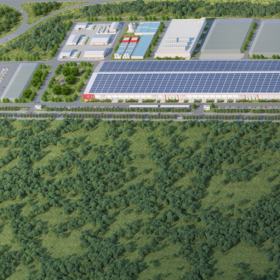
SEG Solar starts building 3 GW solar ingot, wafer factory in Indonesia
U.S-headquartered SEG Solar is constructing a 3 GW ingot and wafer factory in Indonesia. The new production is located at its existing cell manufacturing facility, completing an end-to-end solar manufacturing chain for the company.

Indonesia’ Pertamina to build 50 MW flexible PV production line in Indonesia
PT Pertamina Power Indonesia and HyET Solaris Netherlands are planning to construct a 50 MW pilot factory manufacturing the Dutch company’s lightweight and flexible PV products in Indonesia, with ambitions to scale-up to a GW-size manufacturing facility.

Indonesia think tank seeks partner for offshore floating solar study
Indonesia’s Institute for Essential Services Reform (IESR) is seeking proposals by Dec. 3 for a preliminary feasibility study on offshore floating solar development in Sulawesi, including techno-economic assessments and regulatory analysis.
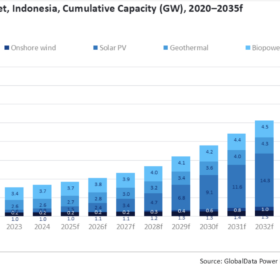
Indonesia expected to reach 23.2 GW of solar by 2035
UK consultancy GlobaData projects Indonesia will surpass 1 GW of cumulative solar capacity this year, before growth accelerates towards 9.1 GW by the end of the decade and 23.2 GW by 2035.

Singapore, China to supply solar-plus-storage power from Indonesia
Singapore’s Equator Renewables Asia (ERA) and China’s CRE International Co. Ltd (CREI) will jointly develop a 900 MW solar and 1.2 GWh battery project in Indonesia, with 400 MW (AC) slated for export to Singapore.

IEA says cost of capital for solar remains high in Southeast Asia
The International Energy Agency (IEA) says the cost of capital for solar remains higher in Southeast Asian countries than it does in other emerging and developing economies.
