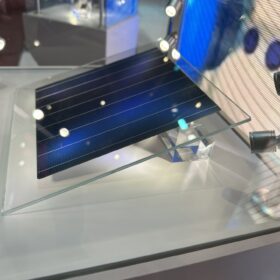
Optimal parameters for perovskite-silicon tandem solar cell manufacturing
Researchers in the Middle East claim to have identified the optimal parameters for the commercial production of perovskite-silicon tandem solar modules across several locations. Their analysis showed that manufacturing costs may currently be as low as $0.387/W, with the prospect of reaching $0.25/W in seven years.

Iraq inaugurates 2 MW solar array at government palace
Iraq has installed a 2 MW solar array at a key government building as part of a broader effort to transition state facilities to renewable energy. The project supports the country’s push for sustainable power use across its public sector.
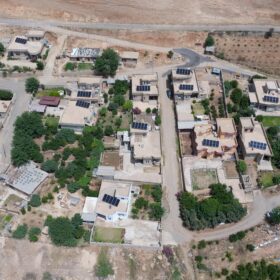
Iraq’s first solar-powered village begins operating
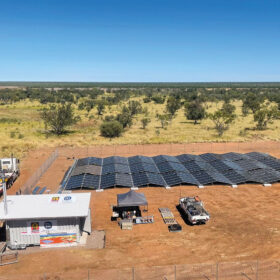
Iraq’s first fully off-grid solar-powered community, developed by the Rwanga Foundation, was inaugurated earlier this week. The village features almost 200 solar panels that will power homes, a mosque, a school and a community hall.
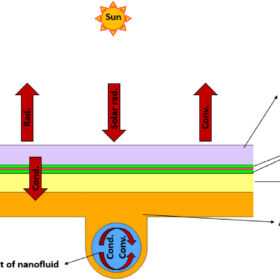
Scientists build photovoltaic-thermal panel hosting four different cooling techs
Researchers from the Middle East have simulated a novel PV thermal module which includes a thermoelectric generator above the absorber layer, conical helical tape in the cooling tube and a ferrofluid. These technologies reportedly contributed to increased PV efficiency and thermal efficiency by 2.12% and 23.34%, respectively.
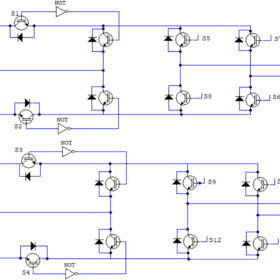
Asymmetrical 49-level cascaded inverter for PV applications
Researchers in Iraq have designed a multi-level cascaded inverter that can purportedly produce high-quality sinusoidal output voltage and current waveforms, while reduing harmonic distortion. It uses the so-called phase disposition level-shifted pulse width modulation (PDLSPWM) control technique to operate the switches in the circuit “effectively.”
New algorithm for fault detection in renewables microgrids
An Iraqi-Canadian research team has created a new algorithm that can detect direction change in the line current of renewables-based microgrids. The novel approach can be applied to both grid-forming and grid-following infrastructures.

Why and where solar PV succeeded in Arab Gulf states
A US-UAE research team has investigated how regulatory regimes impacted solar power deployment across six Arab states of the Persian Gulf. Their findings show that the predominant role of the state is expected to continue.
Scientists use series active filter to improve power quality of grid-tied PV
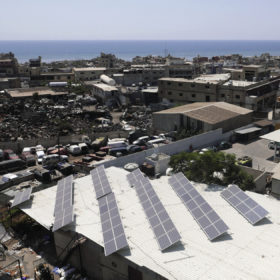
Scientists in the Middle East have developed a series active filter to improve power quality in grid-tied PV systems, consisting of an inductor, two capacitors, and four transistor-diode pairs. The filter reduces total harmonic distortion in voltage and current waves at the inverter output.

Multiple designs of photovoltaic-thermal collectors
Scientists have modeled eight different kinds of PVT systems, some with a glass covers and some without. They found the worst efficiency was achieved in uncovered systems with parallel round tubes.
Coupling photovoltaics with waste-to-energy
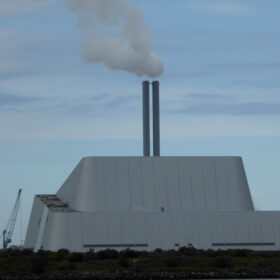
Researchers have simulated the addition of PV plants and waste-to-energy systems in the Iraqi Al-Gharab region, that suffers from power cuts, and have identified the optimal size and locations for these hybrid plants, with the LCOE dropping by 7.7%.
