The Hydrogen Stream: Europe introduces new green hydrogen rules
The European Commission has presented the final version of its new rules for green hydrogen, with looser requirements to qualify hydrogen as “green.”
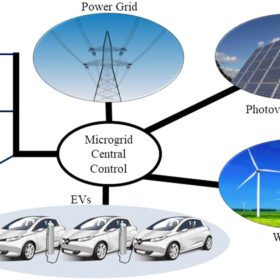
Integration of EV charging stations and renewable energy resources
A new research paper proposes an optimal planning technique to identify the locations and sizes of electric-vehicle (EV) charging stations with controlled charging and hybrid wind and PV systems in a multi-microgrid.
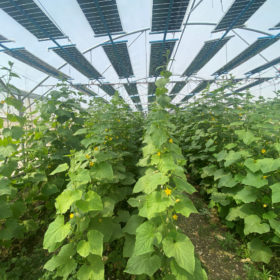
New agrivoltaic project to test crop-responsive PV trackers for greenhouses
An international consortium led by Israel’s Al-Zahrawi Society has launched the Regace project to develop agrivoltaic solutions for greenhouses. It will investigate the performance of a new tracking system across locations and climates and use carbon dioxide enrichment to improve crop yield.

Tandem perovskite-silicon solar cells retained 80% of efficiency after 1 year
Saudi Arabia researchers claim to have improved the outdoor stability of a tandem perovskite-silicon solar cell by using proper encapsulation. By the end of the first year of operation, the cell’s fill factor remained above 70%.
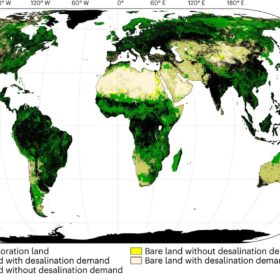
PV-powered seawater desalination for afforestation carbon capture
Finnish researchers have proposed the use of solar, wind, and storage to provide desalinated seawater to restore forests. Their model predicts that an additional 10.7 TW of PV would be needed to actually do this by 2100, leading to a cumulative carbon dioxide sequestration potential of 730 gigatons.

Israel may lift land restrictions for large-scale solar
Policymakers in Israel are trying to create better conditions for large-scale solar projects. Land for ground-mounted facilities is still limited to 2,000 hectares, which equals 2 GW of installed capacity.
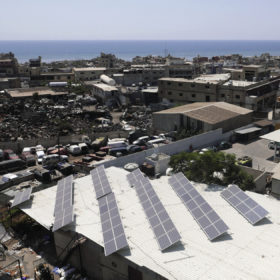
Contractor kicks off tender for 7 MW of solar in Lebanon
DT Global, a US-based development firm, is seeking engineering, procurement and construction (EPC) contractors to build a PV plant with 5 MW to 7 MW of capacity in Lebanon.
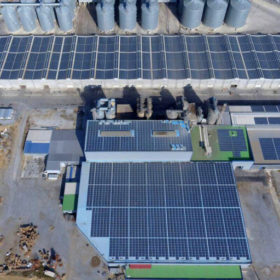
Turkey sets minimum price for solar cell imports
The Turkish government has set a minimum import price of $60/kg, so solar cell imports exceeding this threshold will be subject to import duties. The measure is designed to protect domestic cell manufacturers.
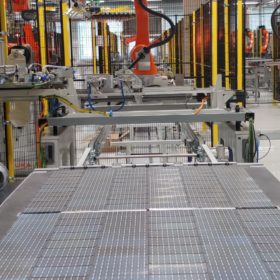
DEWA to procure R&D solar module production line
The Dubai Electricity and Water Authority (DEWA) may install a new R&D production line in its solar R&D center at the massive 5 GW Mohammed bin Rashid Al Maktoum Solar Park.
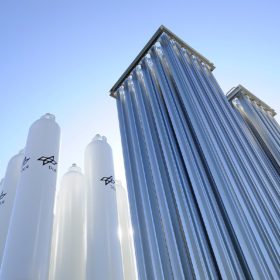
Turkey aims to produce hydrogen at $2.40/kg by 2035
Turkey has released a hydrogen roadmap as part of its plans to meet its 2035 net-zero emission targets, hinging on solar energy and importing electrolysis technologies in the short term. Gulmira Rzayeva, research fellow at the Oxford Institute for Energy Studies, says this target is realistic.
