
The Hydrogen Stream: Chinese companies push for hydrogen transport
CNPC and Sinopec are working on transporting hydrogen via pipelines, while Matrix Renewables has expanded its green hydrogen partnership with Rolwind Renovables.
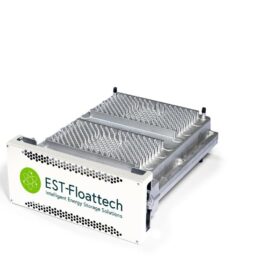
New nickel-manganese-cobalt battery for maritime applications
EST-Floattech has developed a nickel-manganese-cobalt (NMC) energy storage system for maritime applications. The are two versions of the battery modules, with storage capacities of 5.8 kWh or 10 kWh. The company also plans to offer a variant with lithium iron phosphate (LFP) battery chemistry.

Key takeways from SiliconPV 2023
The annual SiliconPV Conference came to TU Delft in the Netherlands last week and offered an important health check for the science and technology behind solar energy. pv magazine was on site to hear the latest from researchers reaching for higher efficiency through tandem cells and other innovations, and working to cut down solar technology’s consumption of rare and expensive materials.
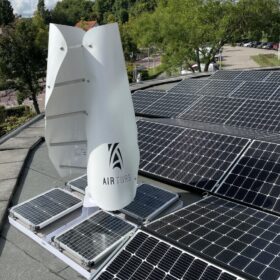
Hybrid wind-solar power system for residential applications
Dutch startup Airturb has developed a 500 W hybrid wind-solar power system featuring a vertical axis wind turbine and a solar base hosting four 30 W solar panels. The system can be used for rooftop or off-grid applications.

Netherlands may hit 180 GW of installed solar power by 2050, say grid operators
A new report from the association of Dutch grid operators predicts strong growth for the Dutch PV sector, regardless of potential international scenarios.
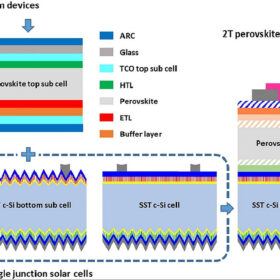
Poly-SiOx solar cell for 4T, 2T perovskite-silicon tandem devices
Scientists in the Netherlands have developed a new crystalline solar cell based on poly-SiOx passivating contacts. The poly-SiOx tech results in a 20% efficiency rating, but 4T tandem perovskite-silicon solar cells based on the poly-SiOx cell can reach an efficiency of 28.1%, and 2T tandem perovskite-silicon devices can hit 23.2%.

Dutch city installs solar footpath
Hungary’s Platio has inaugurated a solar footpath in the Dutch city of Groningen. The installation consists of 2,544 monocrystalline Patio solar pavers with a 21.8% efficiency rating. It will generate 55,000 kWh of electricity per year and can purportedly withstand a pressure of 2 tons without microcracks.
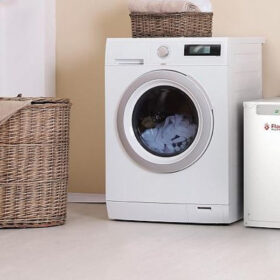
Dutch heating specialist offers solar-tied thermal battery for domestic hot water
Netherlands-based One Solution says its new FlexTherm Eco battery can be used in combination with rooftop PV systems and residential photovoltaic-thermal installations. It consists of a thermal charging station that converts power directly into heat and stores it for the provision of hot water.

European companies raise more than $25 million for heat pump development
UK-based Ideal Heating has announced plans for a new GBP 10 million ($12.5 million) heat pump R&D research center in Hull, England. Heat Transformers, meanwhile, said it has raised €15 million ($16.4 million) to accelerate heat pump deployment in the Netherlands, Germany, and the United Kingdom.
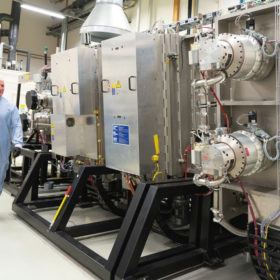
Weekend Read: Industry and researchers in tandem
As efficiency records tumble and devices become more stable, Europe is seeing the beginnings of a race to commercialize high-efficiency perovskite-silicon tandem solar products, reports Valerie Thompson.
