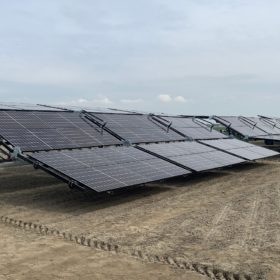
Mobile agrivoltaic system from the Netherlands
Created by a Dutch group of companies and research institutions, the mobile solar system may also be combined with an electrolyzer for hydrogen generation. Two prototypes are currently being tested by a farmer and a research institute in the Netherlands.
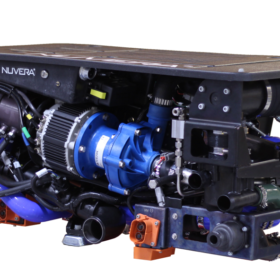
The Hydrogen Stream: Fuel cell engines for stationary power uses
In other news, Airbus and Kawasaki Heavy Industries plan to work together to prepare a hydrogen-fueled ecosystem, while Storgrundet Offshore and Lhyfe want to build a 600 MW hydrogen production plant in Sweden. Furthermore, Canada-based First Hydrogen has identified four industrial sites in the United Kingdom and is advancing discussions with landowners to secure land rights to develop green hydrogen production projects.
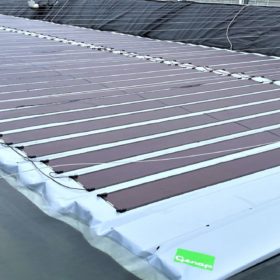
Lightweight solar for agricultural water reservoirs
The Genap Energy Cover uses HyET Solar Powerfoil thin-film solar modules, rated at 12.0% efficiency, for agricultural water storage and reservoirs, with an initial focus on the greenhouse and horticulture markets in the Netherlands. Genap said a 12kWp test setup had a generation density of 60W/m2, rising to 120W/m2 within a year, with an eventual target of 165W/m2.
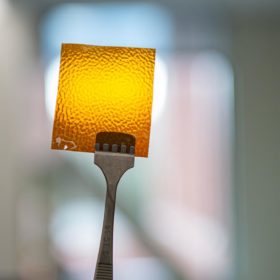
The Hydrogen Stream: Electrochemical pump for hydrogen purification
Research activities on hydrogen are in full swing at Penn State University, University of Aberdeen, Brunel University London, Loughborough University and Cardiff University. This week marks a systemic shift towards hydrogen in research, production, sale and consumption.

Ultrathin photovoltaic silicon membrane with 65% light absorption
A Dutch-British research group is developing a 1μm crystalline silicon membrane with a remarkable optical performance and a hyper-uniform pattern design. A simulation of the device was theoretically able to achieve an absorption equivalent photocurrent of 26.3mA/cm2.
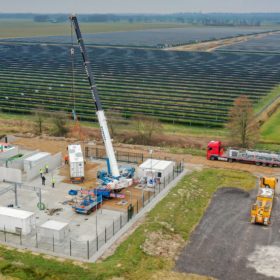
Hydrogen production at Dutch solar park
Alliander and Groenleven have completed construction on the Netherlands’ first green hydrogen production facility. It is connected to a 50MW solar park and is expected to generate hydrogen from June.
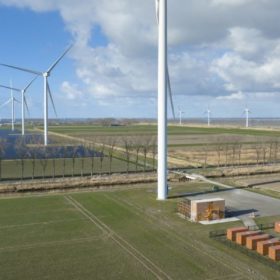
Vattenfall energizes hybrid wind-solar-storage plant in the Netherlands
The Haringvliet energy park consists of a 38MW solar facility a 22MW wind power complex and 12 battery containers. The three systems share the same grid connection.
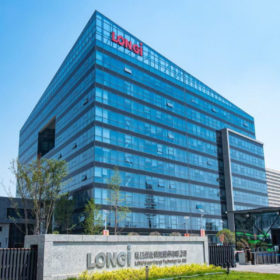
Longi wants to challenge recent ruling in patent dispute with Hanwha Q-Cells in the Netherlands
The Chinese module manufacturer said it will now start preparation of the appeal to The Supreme Court of the Netherlands and the European Court.
Netherlands sets €13bn budget for 2022 SDE+ program, green hydrogen included for first time
Starting from this year, the scheme will also be open to green hydrogen facilities that are directly linked to wind or solar parks, and industrial electrification projects based on hybrid glass furnaces.
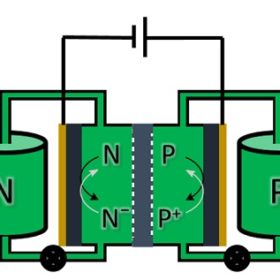
Symmetric redox flow battery based on Blatter radicals
A Dutch-Danish research group has provided a proof of concept for the use of Blatter radicals in electrochemical energy-storage applications. It tested these compounds in a small electrochemical cell that was found to remain stable over 275 charge/discharge cycles.
