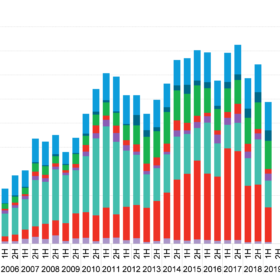
Global renewables investment fell in the first half of this year
While Spain, Sweden, Ukraine and Brazil attracted more funds than last year, China’s transition to an auction-based procurement system and slow performance overall in Europe saw worldwide backing decrease. BloombergNEF does expect investments to ramp up in the second half, however.
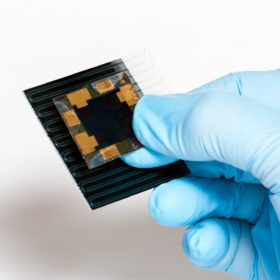
Miasolé sets new flexible CIGS efficiency record
U.S. based Hanergy subsidiary Miasolé has achieved a record 17.44% conversion efficiency for a large area flexible CIGS module. The record has been confirmed by the Fraunhofer Institute for Solar Energy Systems.

German PV equipment suppliers export 99% of their products
First-quarter figures from German engineering association the VDMA showed that, while orders picked up after a slow end to last year, almost all PV production equipment produced in the country is shipped abroad, with China the leading destination.
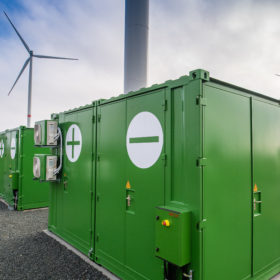
When the battery is a building… or vice versa
AES has announced the start of construction of its Alamito Energy Center, a 100 MW/400 MWh battery for electric utility SoCalEdison which is being constructed as a full-on building – much like a data center.

Solar financing up but policy support is still crucial
Talk of ‘grid-parity’ and ‘subsidy-free’ solar has had industry figures cherishing the ideal of a sector that can operate free of the caprices of government but a peer behind the latest global PV funding figures demonstrates just how dependent on policy the solar industry remains.

‘Turbocharging’ silicon PV: MIT scientists scratch the surface of singlet exciton fission
Scientists at the Massachusetts Institute of Technology have developed a device they say could “turbocharge” a single-junction silicon PV cell, pushing the technology beyond its theoretical limit to efficiencies of 35% and higher.
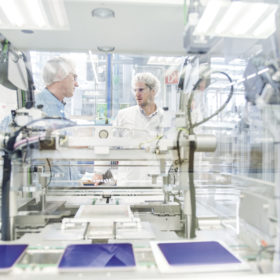
Sorbitol admixture to passivation layer increases HJT conversion efficiency
The race to the theoretical maximum conversion efficiency continues and with new lab results in, it appears a big leap forward may have been achieved at Leibniz University Hannover.

Ideematec banks new investment worth millions for business expansion
The solar tracker supplier is benefiting from a steadily growing PV market and has inked a deal with ABN AMRO Energy Transition Funds for new capital to expand its operations.
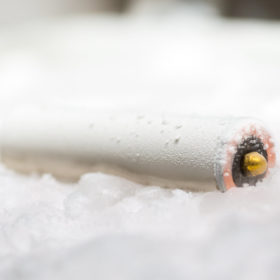
Unlocking lithium metal’s stored potential
Several new concepts in lithium-ion storage technology have the potential to greatly the increase the energy capacity of batteries. Among them are lithium metal anodes, which could potentially increase energy density by more than 50%. With a newly optimized electrolyte, scientists at the University of California, San Diego have taken another step toward making the idea a commercial reality.

Sunnova to go public
The company will list on the NYSE under the symbol NOVA. Sunnova’s prospectus filing reveals information about the company’s finances and operation.
