
No deal: US rejects EU’s WTO request for softer tariffs on solar
Joint communication between the European Union and the U.S. reveals that Washington has not agreed with suggestions from Brussels that EU solar imports were not causing any serious injury and thus should be subjected to a less penalizing tariff.

US scientists gain new insight into inner workings of hybrid perovskites
Researchers at Stanford University and the Department of Energy’s SLAC National Accelerator Laboratory have provided a new understanding of what happens inside a hybrid perovskite material in the first few trillionths of a second after it is hit with simulated sunlight.
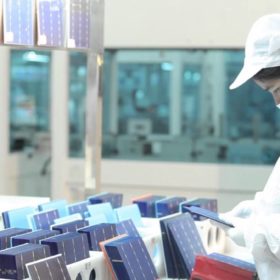
JinkoSolar reveals details of US factory in filing
The plant will make modules based on 158.75 mm square P-type mono PERC cells, and JinkoSolar plans to begin operation in October.
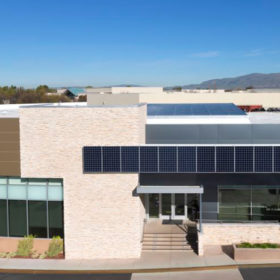
SunPower’s exemption filing strikes to heart of trade dispute
The company, noting its substantial investment in U.S. research and development as well as tools, has further hinted that it may establish U.S. manufacturing for its P-Series modules.
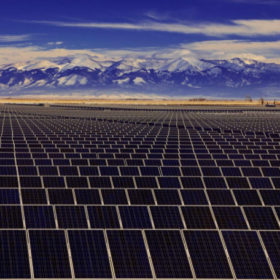
US FERC counts 48 GW-AC of large solar projects planned by 2021
Proposed utility-scale projects have begun piling up at the U.S. federal agency, as the end of the 30% Investment Tax Credit (ITC) draws closer.
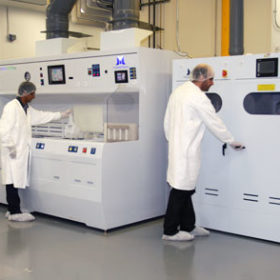
Natcore develops new processes for patented foil cell
U.S. based technology company, Natcore has announced two new processes, which it says could dramatically reduce the production costs of its foil cell, which it has been working to commercialize for the past couple of years.
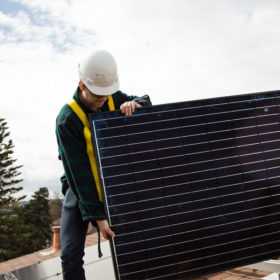
The US residential solar market fell 16% in 2017
GTM Research and SEIA’s final report on the U.S. solar market in 2017 shows both the struggle of the residential sector, as well as a larger than anticipated fall in utility-scale volumes, leading to a 30% contraction overall.
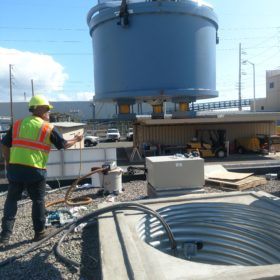
Pilot project for flywheel storage underway in Hawaii
Utility, Hawaiian Electric has announced the start of operations of a pilot project featuring flywheel energy storage technology provided by Amber Kinetics. The project will test the technology’s capability of supporting the grid and allowing further integration of renewable generation.
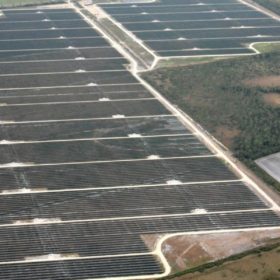
NextEra builds largest solar+storage plant in USA
The power company, which recently placed bids to build the largest battery energy storage project in the world, has connected a 74.5 MW PV project with a 10 MW/40 MWh storage facility, in the United States.
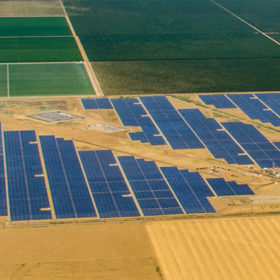
US: Recurrent Energy sells 235 MW-AC of solar power assets to Korean utility
The developer has sold off three large, operational solar plants to the Korea Electric Power Corporation, as parent company Canadian Solar moves into O&M.
