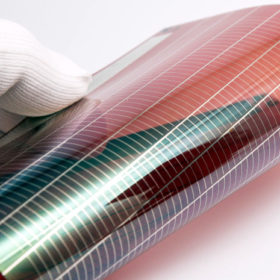
DuPont and Dow finalize merger in $130bn deal
The two firms, which specialize in the production of backsheets and other materials for the solar industry, have completed a merger of equals that has been on the cards for almost two years.
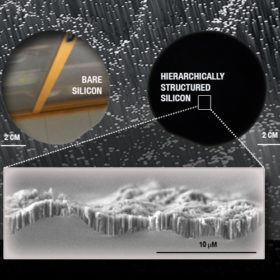
US scientists use nanoscale structures to lower reflectivity in solar cells
The researchers used micro- and nanometer length structures to develop anti-reflective coatings to reduce reflectivity in optical devices such as solar cells, glasses and cameras.

Global solar potential is highly underestimated, study shows
PV can reach a share of 30% to 50% in the global power production by 2050, according to a study conducted by Mercator Research Institute on Global Commons and Climate Change.
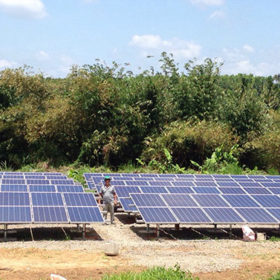
Ontario launches green fund with initial $298 million investment
The authorities in the Canadian province of Ontario have announced the launch of the Green Ontario Fund, with the nation’s leading PV industry body hailing the new scheme as a potential boon for future solar deployment.

Future PV: The feasibility of solar-powered hydrogen production
There is a solid business case to combine PV plants with electrolyzers, as generation costs are low enough to competitively produce hydrogen as a fuel, says Bjørn Simonsen of NEL Hydrogen. He will speak at pv magazine’s Future PV event at SPI in Las Vegas.
Perovskite has changed its status to single (cell)
In another breakthrough for the material so many solar advocates hope will replace traditional silicon in module production, a group of scientists in China and the United States have produced the first monocrystalline perovskite cell, which could accelerate its acceptance as a silicon replacement.

U.S Researchers look to plant photosynthesis to improve solar efficiency
A team of scientists at Georgia State University has discovered a process that occurs naturally in plants. Known as ‘inverted-region electron transfer’, better understanding of this process could contribute to the design of higher efficiency solar cells, says the University.
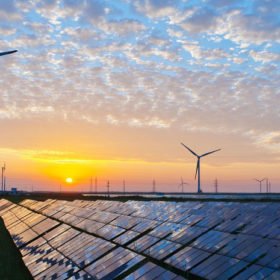
Renewables generate (almost) as much U.S. power as nuclear during H1 2017
The DOE’s latest numbers show renewables rising to 20.05% of U.S. electricity generation during the first half of the year, just behind nuclear’s 20.07%. Solar provided 2% of electricity, and wind 7%.
ReneSola may sell PV production ops to regain NYSE compliance
ReneSola may sell off its indebted polysilicon, wafer and PV module production businesses to regain compliance with the listing standards of the New York Stock Exchange (NYSE).
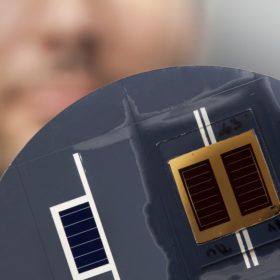
Swiss researchers team with NREL to break 35% cell efficiency
A collaborative project between the U.S. National Renewable Energy Laboratory, the Swiss Center for Electronics and Microtechnology (CSEM) and the École Polytechnique Fédérale de Lausanne (EPFL) has tested a range of multi junction cells in tandem configuration, and achieved efficiencies of up to 35.9%.
