Australia to fund national solar panel recycling pilot
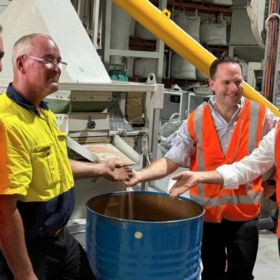
Australia’s federal government will invest AUD 24.7 million ($16.9 million) over three years in a national pilot to recycle end-of-life solar panels, aiming to reduce landfill disposal and recover valuable materials from the country’s growing rooftop solar fleet.
‘An immediate transition to copper is technically and economically feasible’
With silver prices rising, more large solar manufacturers are expected to switch to copper for cell metallization. Radovan Kopecek of ISC Konstanz tells pv magazine that he expects the entire industry to follow. Ning Song of the University of New South Wales says a small efficiency tradeoff may be acceptable if the cost savings are significant and do not introduce new reliability risks.
Australia set for massive utility-scale solar and wind investment in 2026
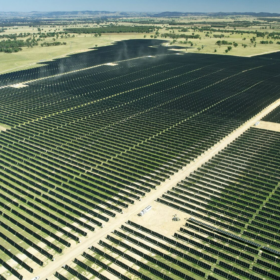
BloombergNEF says Australia will attract AUD 5.1 billion ($3.5 billion) in utility-scale solar and wind investment in 2026, with wind expected to account for about 95% of the total.

Australian startup moves forward with perovskite solar manufacturing plans
Halocell Energy is set to benefit from the development of a sovereign supply chain for high-purity precursors to perovskite after signing a memorandum of understanding with Queensland advanced materials company Lava Blue.
Utility equipment shakeup: Sigenergy enters the large-scale segment
In this pv magazine webinar, discover how Sigenergy is reshaping utility-scale solar storage. Learn their integrated hardware strategy—from power electronics to grid-ready software—and how it simplifies equipment selection and addresses critical solar farm pain points.
Australia approves Fortescue 644 MW Turner River solar farm
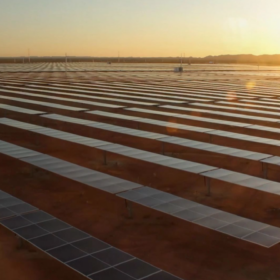
Fortescue’s plans to build one of Australia’s largest solar farms have cleared another regulatory hurdle with the federal government’s environmental watchdog providing the tick of approval for the 644 MW project planned for Western Australia.
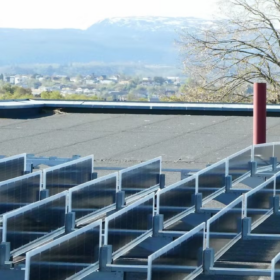
Smart Commercial to roll out prefab vertical rooftop PV system
Smart Commercial Energy has unveiled a new prefabricated vertical rooftop solar system for the Australian market as part of a collaboration with Norwegian clean energy company Over Easy Solar.
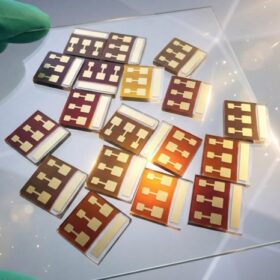
UNSW researchers set new efficiency record of 11.02% for antimony chalcogenide solar cell
The Australian scientists designed the cell with a sodium sulfide additive to achieve uniform sulfur and selenium distribution, improving charge transport.
This controlled elemental layering reduces energy barriers and defects, enabling a certified efficiency of 10.7%.

World’s largest battery-electric ship begins harbor trials in Australia
Incat Tasmania has started harbor trials of the largest battery-electric ship constructed to date. The 130-meter vessel is now moving under its own battery-electric propulsion for the first time.

Not all POE encapsulants protect TOPCon solar cells from corrosion
UNSW researchers found that some POE encapsulants can trigger severe corrosion in TOPCon solar modules, causing up to 55% power loss under damp-heat conditions. Their study highlights that module reliability depends on the exact encapsulant formulation, not just the polymer type.
