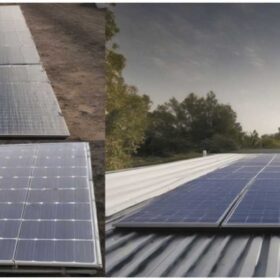
How to address imbalance datasets in solar panel dust detection
Researchers from South Korea improved solar panel dust detection by using SMOTE and stable diffusion (SD) augmentation, with SD boosting detection accuracy from 76.5% to 98.9% while preserving spatial realism.
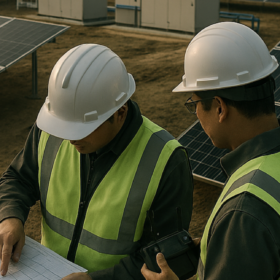
South Korea eases solar siting rules to cut permitting delays for PV projects
South Korea has passed legislative amendments to limit the ability of local authorities to impose separation distances on solar projects, removing a major permitting barrier for PV developers.

South Korean railway operator signs solar deal with Qcells
Korea National Railway has signed a memorandum of understanding with South Korea’s Qcells to expand solar deployment across railway assets as part of its energy transition strategy.

South Korea to invest $223 million in next-generation distributed grid
The South Korean government has announced plans to invest KRW 321 billion ($222.6 million) in 2026 to upgrade regional distribution networks, deploy 85 energy storage systems, and expand solar integration while piloting microgrids and market reforms.

AI can now predict solar cell efficiency from wafer quality
Korea University researchers have developed a machine-learning framework that predicts solar cell efficiency from wafer quality, enabling early wafer screening and optimized production paths. Using over 100,000 industrial data points, the approach combines predictive modeling, process optimization, and explainable AI to support photovoltaic manufacturing.

South Korea’s Won Kwang S&T launches mobile solar panel recycling solution
Won Kwang S&T has developed a mobile, on-site solar module recycling system for utility-scale PV plants. The SolreBorn unit can reportedly process up to 2.5 tonnes of modules per day and improve the economics of solar panel recycling through on-site dismantling and material recovery.
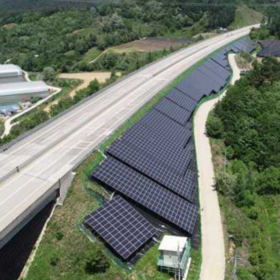
Guided-learning model for PV power forecasting without irradiance sensors
South Korean researchers have developed a guided-learning framework that accurately predicts PV power without requiring irradiance sensors during operation, using routine meteorological data instead. The model reportedly showed strong out-of-sample performance while outperforming conventional irradiance-based approaches, particularly under noisy or inconsistent data conditions.

Korean scientists boost performance of tin monosulfide cells with new post-treatment
Researchers in South Korea improved the performance of tin monosulfide (SnS) solar cells with a potassium fluoride-assisted post-treatment and a vapor transport deposition process. The treated solar cells had a power conversion efficiency of 4.10% and reduced recombination sites, compared to 3.42% for untreated devices.
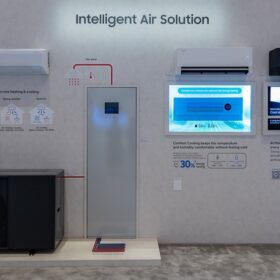
Samsung releases new all-in-one heat pump for residential use
The South Korean giant said its new EHS All-in-One provides air heating and cooling, floor heating, and hot water from a single outdoor unit. It can supply hot water up to 65 C in below-zero weather.

Korean scientists build mini perovskite solar module with 22.56% efficiency
GIST researchers have developed a perovskite mini-module with 22.56% efficiency by improving the SnO₂ electron transport layer with PEI, reducing defects and electron loss. The module retained 94% of its performance after 500 hours, highlighting potential for scalable, stable perovskite solar cells and modules.
