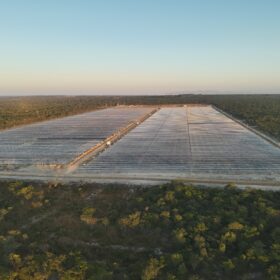
First merchant solar plant enters South African Power Pool trading
UK energy trader BB Energy has commissioned a 25 MW merchant solar plant in Zambia, marking the first such facility to join the South African Power Pool market. A 35 MW expansion is planned for completion later this year as part of a 118 MW target by 2027.

Novel MPPT method combines APO, model-predictive control
An international research team has tested a hybrid control technique combining adapted perturb and observe (APO) with model-predictive control to address complex partial shading in solar arrays. The method, validated through simulation and physical experiments, reportedly outperforms existing approaches.

Afreximbank backs 1 GW floating solar project in Zimbabwe
African Export-Import Bank (Afreximbank) has committed $4.4 million to finance bankability and feasibility studies for a proposed 1 GW hybrid floating solar project on Lake Kariba in Zimbabwe.

Eskom tenders 72 MW of solar
South African utility Eskom is searching for a developer to design, procure, supply, test and commission a 72 MW solar project at the site of an existing power station. The deadline for applications is Sept. 30.
Sun King secures $156 million to expand off-grid solar in Kenya
Sun King has secured a $156 million deal backed by Kenyan banks and international development finance institutions to expand off-grid solar access in Kenya, financing the purchase of about 1.4 million solar products and smartphones.

South Africa approves six solar projects totaling 1,290 MW
An additional six solar projects have been approved as part of South Africa’s seventh renewables procurement round following the reallocation of unused onshore wind capacity to solar bids.
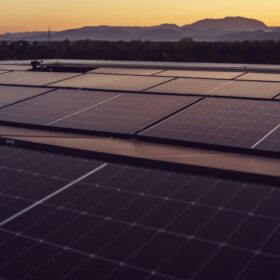
Burkina Faso set for 150 MW solar-plus-storage project
Dutch developer Gutami Holding has signed a 25-year power purchase agreement with Burkina Faso’s national utility to supply electricity from a planned 150 MW solar project paired with 50 MWh of storage.
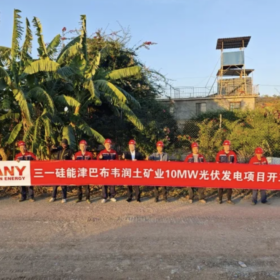
Zimbabwe starts construction on 10 MW solar plant
China’s Sany Silicon Energy is building its first solar plant in Zimbabwe. The project uses the company’s EP+F business model combining engineering, procurement and financing.

Madagascar signs deal to develop 50 MW of solar with 25 MWh of storage
Global South Utilities (GSU) has secured agreements with Madagascar to develop a 50 MW solar plant and a 25 MWh battery energy storage system (BESS) in the island nation.

The best tilt angle to improve PV system performance on low-cost buildings
Researchers have demonstrated that the theoretical optimal tilt for rooftop solar energy production in low-cost buildings in Nigeria is approximately 5.67°. Their modeling suggests to adopt south-facing roofs for PV generation in the Global South.
