
Switzerland launches tender to assign free-of-charge areas for PV along highways
The Swiss Federal Roads Office (FEDRO) started yesterday the selection process to assign these areas free of charge to solar developers. Interested developers will have time until February 24 to express their interest in these surfaces.
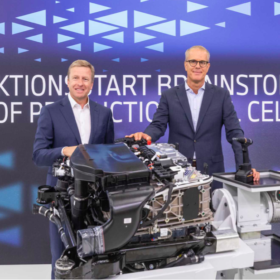
The Hydrogen Stream: BMW starts in-house production of fuel cells for iX5 Hydrogen
BMW Group said it is targeting the premium segment with its iX5 Hydrogen car, Topsoe revealed that it will invest $267 million to build the world’s largest SOEC electrolyzer plant in Denmark, and Bosch announced plans to invest $200 million in US fuel cell production.
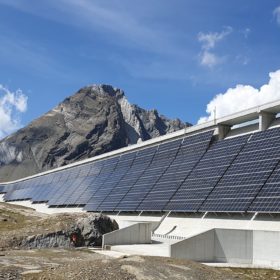
Axpo commissions 2.2 MW vertical alpine PV project on dam
Axpo said its new 2.2 MW system is the largest alpine solar plant in Switzerland. It is expected to supply around 3.3 million kWh of electricity per year, with an above-average electricity yield in the winter months.
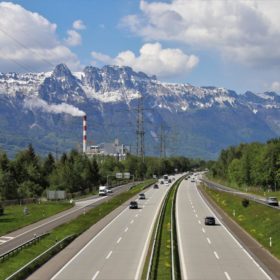
Switzerland wants to deploy solar along highways
The Swiss Federal Council has amended the National Roads Ordinance to allow the country to generate renewable energy on free surfaces along major thoroughfares, such as noise barriers and rest areas.
Long-term, heat-based energy storage in aluminum
Nine partners from seven European countries are involved in the €3.6 million ($3.7 million) “Reveal” research project, which says buildings could be heated in the future by storing energy from PV, wind and water in aluminum.
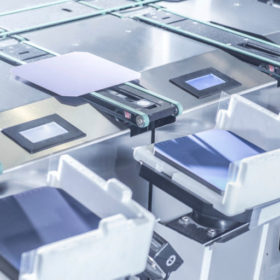
Meyer Burger ramps up solar panel plans
Switzerland’s Meyer Burger is accelerating the expansion of its solar panel production capacity, following the extension of the US solar tax credit for PV manufacturers and an order from developer DE Shaw for 3.75 GW of US-made heterojunction modules.
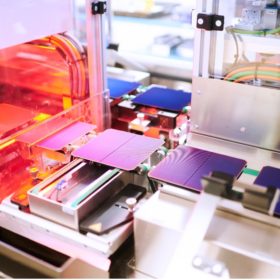
Meyer Burger secures silicon wafer supplies from Norway
Meyer Burger has announced that it has concluded a binding supply agreement with Norwegian Crystals for silicon wafers to use in heterojunction cell manufacturing. Hydro facilities primarily power the production of the wafers and their precursor materials in Norway. Combined with the shorter distance they’ll have to travel, this adds up to a low carbon footprint.
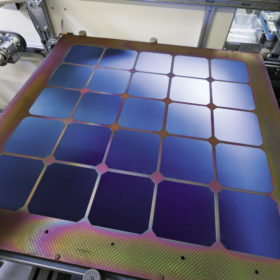
Meyer Burger expects higher prices, lower solar module output
Swiss panel manufacturer Meyer Burger wanted to increase the annual capacity of its production lines this year, but the ramp-up has been delayed due to ongoing bottlenecks in global supply chains.
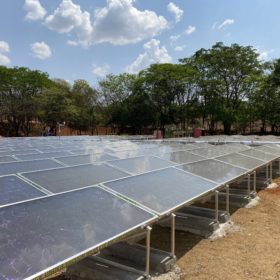
Solar thermal panel for large scale applications
The panel has an absorption area of 1.96 m2 and a weight of 27 kg per square meter. According to the manufacturer – Swiss startup TVP Solar – it may be a real booster for thermal output, by combining it with photovoltaics and heat pumps to provide enhanced output per square meter, in particular for low-temperature applications such as district heating.
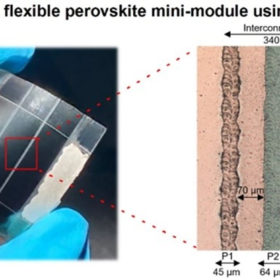
Four-terminal flexible perovskite-CIGS tandem mini-module with 18.4% efficiency
Swiss scientists have built a 4T tandem perovskite/CIGS mini-panel with a geometric fill factor of over 93%. It combines a 10.8%-efficient mini perovskite module and a 15.1%-efficient CIGS device.
