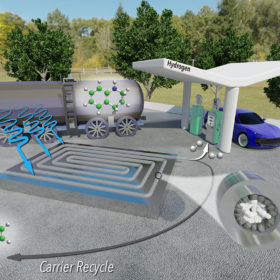
The Hydrogen Stream: Novel tech for extracting hydrogen gas from liquid carriers
North Carolina State University (NCSU) has developed an energy-efficient strategy for room-temperature hydrogen release from liquid hydrogen carriers, which uses less rhodium. Elsewhere in the world, Airbus launched its Zero Emission Development Centre in the UK, Toshiba ESS teamed up with Fusion Fuel to target Australian and European markets, and Corfo signed agreements to finance three renewable hydrogen projects with GNL Quintero, iCAP, and Air Liquide in Chile.
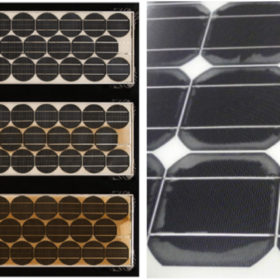
PV module degradation mechanisms at a glance
An international team of researchers have published a review of all factors affecting PV module performance. They looked at mainstream crystalline silicon technology, thin-film solar, perovskites, and organic solar cells, and offered insight on reliability, quality and testing standards.

British developer gets green light for 200 MW battery
The Heysham site is intended to reduce curtailment from half a dozen offshore wind farms and to replace local grid services which will be lost when two nearby nuclear reactors are powered down.

Multifaceted ferrocene interlayer for 23.45%-efficient perovskite solar cell
The cell stability was improved with the addition of ferrocene at the perovskite/spiro-OMeTAD interface. It was able to retain around 70% of its initial efficiency after 1,250 hours.

Solar and heat pumps drive UK’s public sector net-zero plans
Solar panels accompany heat pumps on a significant number of the projects being funded by the UK government to reduce carbon emissions from public buildings – but not in Scotland.

The Hydrogen Stream: Renault presents electric-hydrogen hybrid car with range of up to 800 km
In other news, Shinshu University researchers developed a graphene-wrapped molecular-sieving membrane that is reportedly 100 times more efficient than that of conventional polymer separation membranes. Topsoe aalso nnounced the construction of the “world’s largest electrolyzer production facility,” and Toho Gas said it would produce blue hydrogen in Japan for local consumption.
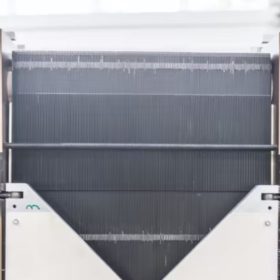
UK group developing floating organic flow battery storage project
MSE international and its partners have concluded the feasibility study for an organic large-scale flow battery project in Portsmouth, England. The 650 kW/6.1 MWh project might end up having have a lower levelized cost of electricity than lithium-ion or vanadium redox flow batteries.
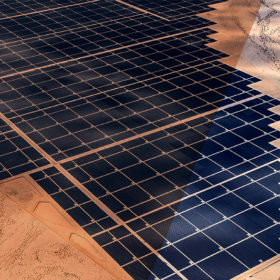
UK investor supports 10.5 GW wind-solar project in Morocco with submarine cable
UK-based Xlinks plans to build 10.5 GW of wind and solar in Morocco and sell the power in the United Kingdom. London-based investment firm Octopus Energy said it joined forces with the project developer, Xlinks, to help it move forward with construction.
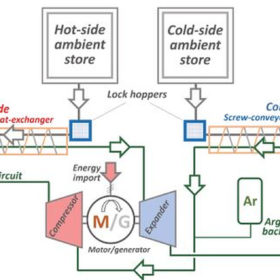
UK startup develops Brayton pumped thermal tech for renewables storage
UK-based Synchrostor has developed a new pumped thermal energy storage (PTES) system. It is purportedly fully reversible in 30 milliseconds and can achieve a round-trip efficiency of around 70%. The proposed storage technology can also provide grid inertia and ancillary services.
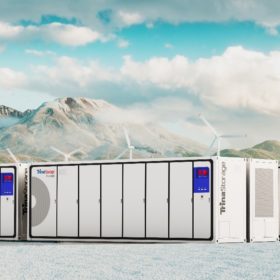
Trina launches grid-scale storage solution
Trina Storage’s new 2.1 MWh DC All-New Elementa solution is a modular LFP battery cabinet with a plug-in concept to connect multiple units. The company is ramping up battery manufacturing capacity to strengthen vertical integration, given supply chain risks throughout the world.
