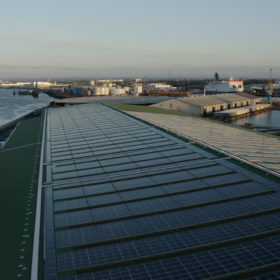
UK added 175 MW of solar in first quarter
More than 7% of the U.K.’s solar generation capacity is now unsubsidized, according to trade body Solar Energy UK, with the nation reaching more than 14 GW of photovoltaic projects during the first three months of the year.

The weekend read: New pathways in flexible thin film PV
Having picked up GBP 5.8 million ($8 million) in a series of investments, U.K.-based Power Roll is pushing ahead with pilot production of an innovative new thin film with which it can manufacture both solar modules and capacitors. In the future, the design could also bring the potential for solar generation and energy storage within a single lightweight device.
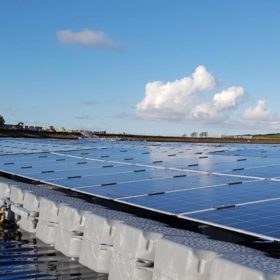
How much floating PV is enough?
Scientists in the UK have had a closer look at the impacts of floating PV systems on the water. They found that their cooling effect on water mitigates blooms of toxic blue-green algae and increased water evaporation, which are both caused by global warming. They also warned, however, that colder water may result in a reduction of the duration of so-called thermal stratification. The right proportion between the surface occupied by the PV array and a water surface’s total area is key for addressing this issue.
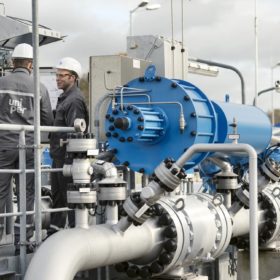
Incentives crucial to avoid green, blue, and even purple hydrogen fading to grey
An Anglo-German report has suggested the environmentally-friendly desire to use only clean power to produce hydrogen, outlined by nations such as Germany, could end up being more emissions-heavy than the more pragmatic embrace of blue hydrogen under consideration in the U.K.

Spanish solar renaissance lifts world to record year for large scale projects
A global ranking of large scale solar project capacities indicates prominent roles for a resurgent Spain, behind the usual top three of China, the U.S. and India, with Australia and the Netherlands also on the rise. There were disappointing returns, though, for the U.K., Italy and Canada.

UK start-up builds gravity-based storage system at Scottish port
Scottish start-up Gravitricity has begun construction of a 250 kW gravity-based energy storage project at Port of Leith. A 15m-high rig uses renewable energy to raise a mass in a 150-1,500m shaft and discharges the electricity thus ‘stored’ by releasing the mass to rotate an electric generator.

Solar could play big role in helping renewables displace UK’s planned gas fleet
Each 1.8 GW of new gas generation capacity could be replaced by 1.7 GW of solar as part of a cleaner, 6.3 GW collection of renewables and energy storage facilities–and that alternative already comes in cheaper than the business-as-usual approach, according to the Carbon Tracker thinktank.

Passive solar module cooling based on hydrogels beads and nanofluids
A British-Egyptian research group has tested the use of hydrogels beads for PV module cooling. The micro-sized particles were saturated with aluminium oxide (Al2O3) water-based nanofluids and placed below the simulated PV panels. The experiment showed, according to the scientists, that the hydrogels beads were able to significantly reduce the temperature by between 17.9 and 16.3 degrees Celsius.

Six new ways to boost battery energy density
Scientists in the UK developed a model to explain one of the challenges to harnessing an oxygen-redox reaction in certain cathode materials for lithium-ion batteries. Based on their improved understanding of the reaction, they suggest several possible routes for further research to avoid the unwanted reactions and develop reversible, high energy density cathode materials.

Shell acquires Next Kraftwerke
Through the operation, Shell wants to consolidate its position in the virtual power plant market.
