
Storing renewables in soil mounds via water balloons
Scientists in Denmark have developed a storage technology that utilizes large underground water balloons and the pressure of the soil to activate a turbine to generate power. They are currently building a first 10 m x 10 m demonstrator to select critical technologies related to the membrane and to the construction of the “movable hill” that will form the terrain part of the battery.
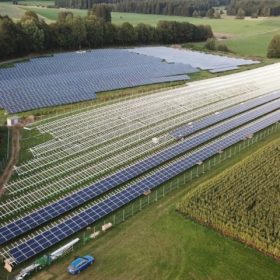
Germany deployed 3.8 GW of PV in first half of 2022
In June alone, new PV systems totaling 612 MW were connected to the German grid. The country’s cumulative operational PV capacity reached 59.9 GW at the end of June.
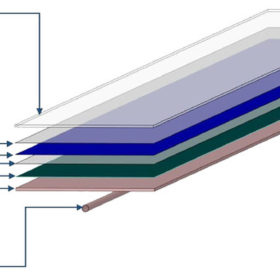
Photovoltaic thermal panel with overall efficiency of 83% via MXenes nanofluid
UK researchers have demonstrated a photovoltaic thermal panel that utilizes an MXene/water nanofluid for heat transfer. They said the nanofluid is not only able to improve the thermal and electrical performance of the panel, but also to reduce its size by 14.5%.

Manz exits solar business
The German PV equipment manufacturer said it will discontinue all activities in the CIGS thin-film area after writing off €23.2 million due to a failed fab project in China.

Forecast methodology for photovoltaic power yield during solar eclipses
In October there will be a partial solar eclipse in Central Europe. The Fraunhofer IEE has developed a solution that reportedly enables the most accurate forecast possible of the photovoltaic feed-in power during the extreme event.
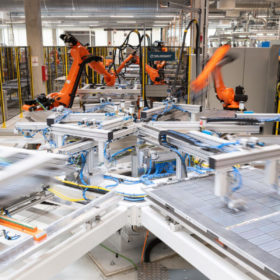
Solarwatt obtains ‘cradle-to-cradle’ certification for its glass-glass solar modules
The ‘cradle-to-cradle’ certification is considered a globally recognized holistic product quality standard. The assessment is made for five categories: material health, recyclability of materials, energy management and CO2 emissions, water management and social responsibility

The Hydrogen Stream: $8 billion green hydrogen facility near the Suez Canal
Egypt is taking several steps to support renewable and hydrogen projects, aiming to produce 42% of its electricity from renewable sources by 2030. Meanwhile, a team of researchers led by UCLA developed a method for predicting platinum alloys’ potency and stability; Iberdrola and bp are working on strategic collaboration, including large-scale green hydrogen production hubs in Spain, Portugal and the UK.
Saudi crown prince bears green energy gifts to Greece, but little action seen
Saudi Arabia’s crown prince traveled to the Greek capital of Athens this week, representing his first official trip to Europe since the 2018 killing of Saudi journalist Jamal Khashoggi. His visit was marked by the signing of several agreements between the two countries and some big statements issued by the Saudi leader regarding green energies and hydrogen.
Ardian acquires majority stake in GreenYellow
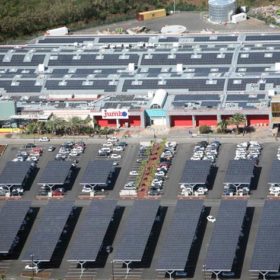
Ardian said that GreenYellow’s value is estimated at around €1.4 billion ($1.42 billion).
Graphene/silicon heterojunction solar cell with 18.8% efficiency
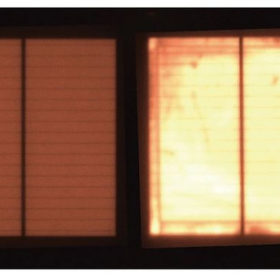
A Chinese-German research group developed the cell with an ink of graphene oxide (GO) mixed with Nafion that can be spin-coated on an n-type silicon wafer to form a high-quality passivating contact scheme. The GO:Nafion layer simultaneously creates a p–n junction with silicon and passivates the surface defects at the GO:silicon interface.
