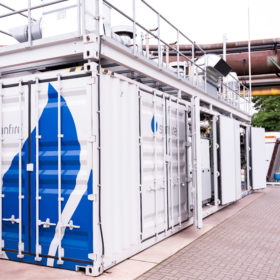
The Hydrogen Stream: Salzgitter claims record efficiency for largest high-temperature electrolyzer
Salzgitter has claimed a record efficiency level for its EU-funded GrInHy2.0 hydrogen project, which is based on solid oxide electrolysis cell tech. The high-temperature electrolyzer uses waste heat from the company’s steel production processes.

The mobility rEVolution: Honda ups the ante on EVs, solid state batteries
In other news, further Covid-19 lockdowns in China continue to negatively impact the EV battery supply chain and broader industry, Porsche is testing V2G capabilities, and Israeli startup Electreon announces extension of its wireless dynamic EV charging project in Sweden.
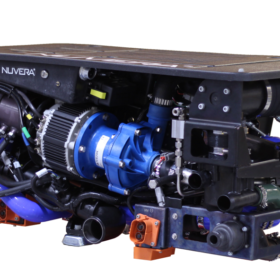
The Hydrogen Stream: Fuel cell engines for stationary power uses
In other news, Airbus and Kawasaki Heavy Industries plan to work together to prepare a hydrogen-fueled ecosystem, while Storgrundet Offshore and Lhyfe want to build a 600 MW hydrogen production plant in Sweden. Furthermore, Canada-based First Hydrogen has identified four industrial sites in the United Kingdom and is advancing discussions with landowners to secure land rights to develop green hydrogen production projects.
The Hydrogen Stream: Heavy-duty hydrogen refueling station in Germany
Everfuel has signed a deal to build a hydrogen refueling station in Germany, while the European Hydrogen Backbone initiative has accelerated its own program to produce 20.6 million tons of renewable, low-carbon European hydrogen. Separately, the UK government published its hydrogen investor roadmap to 2030.
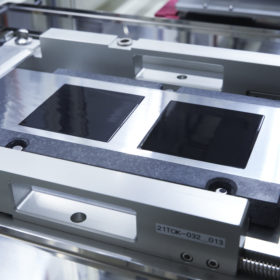
The mobility rEVolution: Nissan moves forward with in-house all-solid-state battery production
In other news, GM and Honda are jointly developing affordable EVs, the Biden administration holds an EV industry meeting, and Mercedes-Benz Energy agrees to supply EV batteries to BatteryLoop for its scalable, circular energy storage products.
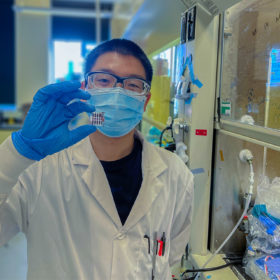
Quantum adjustments for 23.9%-efficient inverted perovskite solar cell
Scientists in Canada fabricated a perovskite solar cell based on an inverted structure that achieved 23.9% efficiency, and maintained 92% of its initial performance after 500 hours of accelerated aging tests. By carefully controlling the thickness of the perovskite layer, the group was also able to gain control of “quantum mechanics” properties such as the movement of electrons within the layer and the wavelengths of light absorbed.

Solar power on pace to save the world
A think tank analysis suggests that if solar power keeps up its growth pace, along with wind, then the global power sector will meet its carbon reduction targets to keep world temperatures in check.

New report calls for collective action to address forced labor risks in the PV value-chain
As the world woke up to the news of war in Ukraine, the German Bundestag called a special session at which the finance minister, Christian Lindner, announced a package of measures in response to the crisis. A key plank, he said, would be a new focus on renewables.
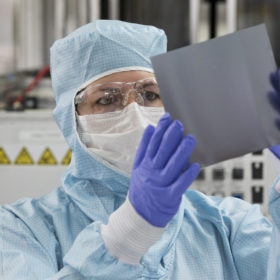
New technologies, new opportunities
UK-based analyst Exawatt and Germany’s Nexwafe published a white paper this week that takes a close look at the current state of PV manufacturing worldwide, and how Nexwafe’s innovative wafer production tech might fit into it. They said that if the potential of its Epiwafer can be realized, the PV industry may yet see “another revolution in wafer manufacturing.”
The Hydrogen Stream: New tech for solar water splitting
Helmholtz-Zentrum Berlin has unveiled new technology to improve thin metal oxide films for solar water splitting, and the European Energy Exchange has announced plans for a new hydrogen index. Indian Oil, Larsen & Toubro, and ReNew have agreed to set up a joint venture to develop India’s green hydrogen sector. And Iberdrola has revealed a plan to produce industrial green hydrogen, in cooperation with the European Investment Bank.
