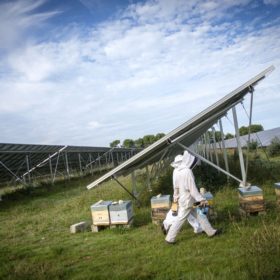
Beekeeping at existing solar parks in France
Engie Green has joined forces with the associations France Nature Environnement and Apicluster to install beehives at several of its solar PV parks in the Provence-Alpes-Côte d´Azur region, in southern France.
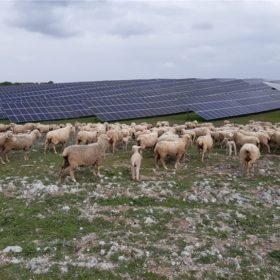
Iberdrola seeks innovative solutions for agrivoltaics
The Spanish utility said agrivoltaic projects and solutions will be evaluated based on costs, technological maturity, crop diversity, and level of digitization among other things.
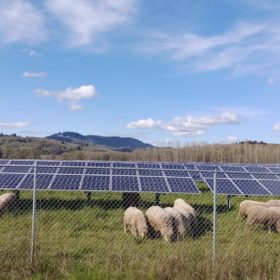
Agrivoltaics increases land productivity, improves animal welfare
New research from the United States has shown the numerous advantages of combining lamb grazing with solar power production. The researchers found, in particular, that the overall return from grazing was the same in both solar pastures and open pasture fields with no PV panels.
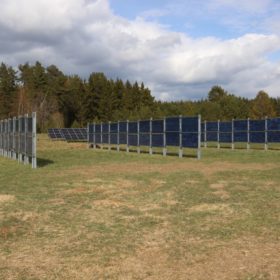
Optimization algorithm for vertical agrivoltaics
Developed by Swedish scientists, the proposed algorithm is said to calculate a project’s ideal design by combining climatological data with figures on expected solar power generation, shading distribution, water for irrigation, and agricultural yield. Its creators spoke with pv magazine about the key parameters that the model seeks to determine, one of which is the optimal distance between the solar module rows depending on the kind of crop.

Italy devotes €1.1bn to agrivoltaics, €2bn to energy communities and storage
The funds will be part of the EU Covid-19 recovery package. Overall, the Italian government expects to deploy 2 GW of agrivoltaics and 2 GW through energy communities.
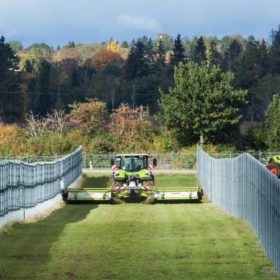
German organizations outline new standards for agrivoltaics
Representatives from 15 agricultural and solar businesses, research entities, and certification bodies in Germany have developed DIN SPEC 91434, a new set of proposed standards for agrivoltaics.
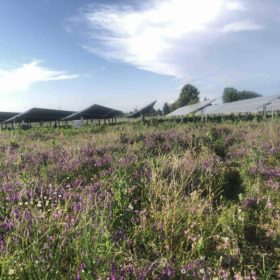
Pollinator-focused solar parks
Researchers in the US ascertained that the partial shading provided by solar parks creates a microclimate that favors the abundant growth of more varied flowers and pollinators. They also found that partial shading increases bloom abundance by delaying bloom timing, increasing forage for pollinators during the hot and dry late season.
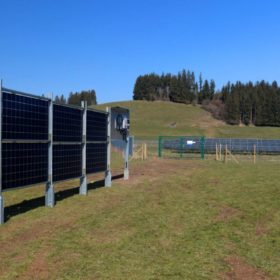
German power provider tests vertical agrivoltaics
Lechwerke is testing two pilot systems close to existing solar parks. It also aims to build its first large-scale project.
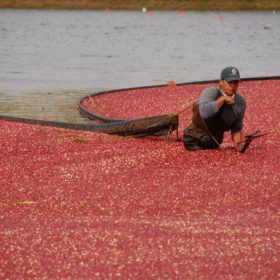
Agrivoltaics plus storage at US cranberry bogs
Pine Gate Renewables has announced plans to deploy 9 MW of solar and 36 MWh of storage above a commercial cranberry bog.
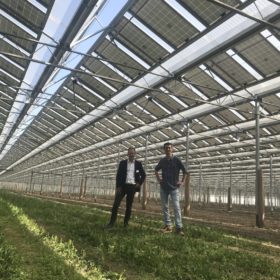
French photovoltaic greenhouse delivers 3.1 GWh and 4 tons/hectare of asparagus in one year
The solar greenhouse was built by French developer Tenergie in 2017 and last year recorded a remarkable performance in terms of both agricultural ane electricity yield.
