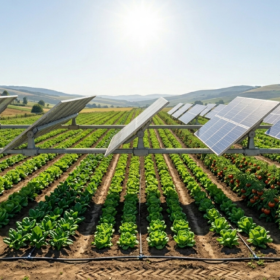
Plug-and-play control framework for adjusting panel tilt in agrivoltaics
A Cornell University research team developed a control framework that simultaneously considers past and future conditions when determining solar panel tilt angle. The researchers told pv magazine it is designed to be plug-and-play, allowing for software developers and solar operators to incorporate their optimization algorithms directly into the framework.
South Korea’s first agrivoltaics law leaves half of farmland off-limits
South Korea’s National Assembly has passed the country’s first dedicated agrivoltaics legislation, enabling dual use of agricultural land for solar power generation, but the law excludes zones covering nearly half of the country’s farmland, according to a Seoul-based nonprofit group focused on energy transition.

Assessment of Nigeria’s agrivoltaic potential identifies northern states as optimal areas
A geospatial assessment of agrivoltaic potential in Nigeria finds greatest opportunity in the country’s northern regions with plentiful cropland, high solar irradiance and low electricity access rates. It calculated that meeting projected mid-century solar demand in the states of Kano, Katsina and Jigawa could be achieved by installing agrivoltaics on less than 1.5% of cropland.

How to electrify greenhouses with semi-transparent PV, heat pumps
Researchers in Canada found that 69%-transparent crystalline silicon semitransparent PV modules can improve tomato greenhouse yields by up to 38% while maintaining healthy plant growth through beneficial partial shading. Their simulations also showed that combining rooftop agrivoltaics with heat pumps can fully eliminate fossil fuel heating.
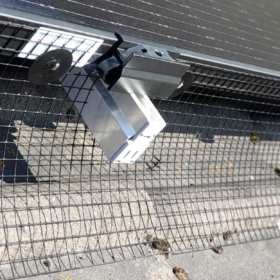
Sassmann develops ‘solar panel grid’ for pigeon protection
Sassmann, a Germany-based company, has developed a modular “solar panel grid” system designed to prevent pigeons from nesting beneath photovoltaic modules.
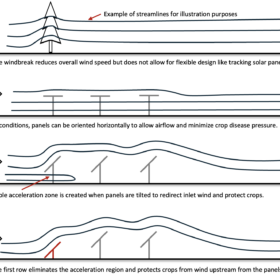
Tracker-based agrivoltaics turn fields into wind-safe zones
Cornell University researchers demonstrated that tracking solar panels in agrivoltaic systems can protect crops from wind damage while allowing airflow, outperforming traditional single-row tree windbreaks. They also proposed a new lowered-first-row panel design that improves wind protection, achieving up to 86% reduction in shelter-zone wind speeds under extreme conditions.
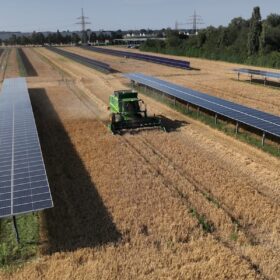
Agrivoltaics with trackers, vertical systems offer economic upside
An industry analysis argues that agrivoltaic systems using trackers or vertical designs can outperform conventional solar on both revenues and land use, challenging conclusions from a recent German study.
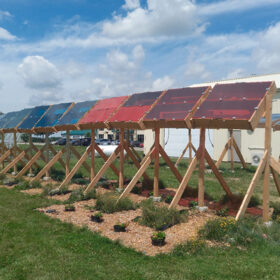
Agrivoltaics for turnips
Researchers in Canada found that semi-transparent cadmium telluride and low-transparency crystalline silicon solar panels can boost turnip root and leaf yields in agrivoltaic systems by optimizing light quality, distribution, and heat stress. Their study highlights that PV module type, transparency, and spectral transmission must be carefully matched to plant physiology to maximize both crop productivity and renewable energy generation.
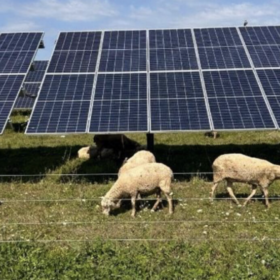
Solar sheep grazing delivers margins up to 40% in new study
Researchers at Western University say agrivoltaic sheep grazing models in Ontario outperform traditional farming, with higher margins and dual revenue streams from livestock and solar site services.
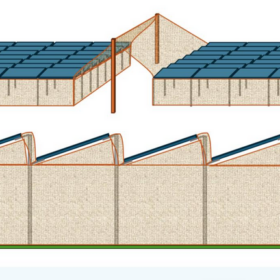
The case for ground-level agrivoltaics
German engineering firm BEC Energie Consult has developed a substructure for low-mounted agrivoltaics designed to provide cost-efficient installation while supporting crop growth and livestock management, with the potential to enhance economic viability.
