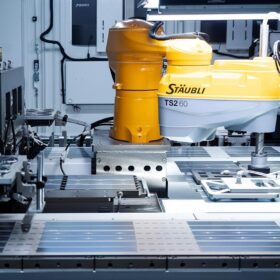
Tongwei achieves 91.7% bifaciality factor for 722 W TOPCon solar module
The Chinese manufacturer said the result was confirmed by TÜV Rheinland. It was achieved through a sunken pyramid structure that reportedly achieves selective-texture on the non-electrode area of rear-side and a zebra-crossing passivation contact structure that is said to ensure excellent passivation.
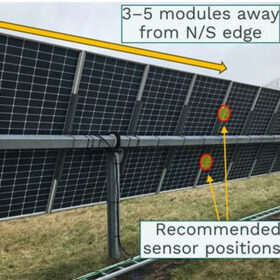
New approach to measure rear plane-of-array irradiance in bifacial PV plants
Researchers in Denmark claim to have identified the best locations for rear plane-of-array irradiance sensors on the back of single-axis trackers in bifacial PV projects. Their work suggests how to reduce sensor quantities while maintaining accurate performance monitoring.

Optimal tilt angle for bifacial PV deployed on white-painted ground surfaces
Scientists in India have analyzed the performance of a bifacial PV module installed on a white-painted ground surface and have found a 30-degree tilt angle outperforms all other inclinations angles in terms of power output.
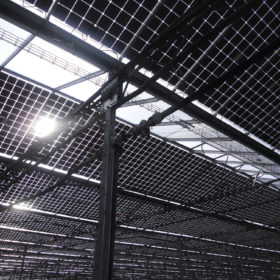
Satellite method estimates albedo for bifacial PV systems in ‘worst-case scenario’ areas
Scientists in the UK have utilized data from two different satellites – Sentinel-2 and MODIS – to develop a new and more accurate approach to estimated albedo for bifacial PV systems in complex landscapes. The novel methodology reportedly achieved a much lower normalized root mean square error than reference methods relying on MODIS only.
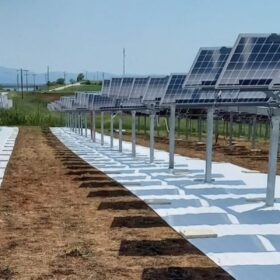
Developer using membranes to increase bifacial solar module yield by 6.4%
Germany-based Solar Kapital has used membranes at three of its PV plants in Greece. It claims that the payback time of the new solution is relatively short.
Dutch researchers propose modified IEC 61853 standard for bifacial solar
Scientists in the Netherlands have proposed the extension of the IEC 61853 standard to bifacial solar modules, with some key corrections. In particular, they recommend changing the third and fourth parts of the standard.
Behind PID in bifacial solar cells
New research from Germany outlines mechanisms behind a form of potential-induced degradation specifically affecting the rear side of bifacial solar cells. Results suggest that the issue may be more complex than previously thought; and avoiding irreversible damage to cells in the field will require a rethink of testing standards.

How much glass is needed for terawatt-scale PV?
German scientists have assessed demand for resources such as glass and silver until 2100 and have found that current tech learning rates could be sufficient to avoid supply concerns.
Boosting bifacial panel efficiency with albedo ground covers: Field test results
Tests by 7X Energy show that ground cover material showed promise, but projects will likely still need to prove the long-term durability, degradation rates, and validation of installation labor and O&M.
Satellite-derived datasets to measure ground albedo for bifacial PV
A researcher from the NREL has set up a series of datasets of measured ground albedo values using measurement network data in the U.S. and data contributed by the PV industry. The measured albedo datasets are intended to help developers of ground-mounted PV projects in making a choice between monofacial and bifacial panels.
