Physics-based model to predict soiling losses in bifacial solar modules
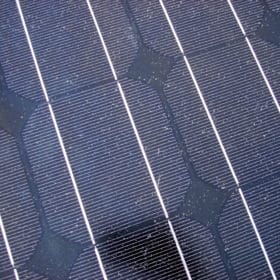
Scientists in India have developed a novel way to predict soiling accumulation on bifacial modules. Their approach considers dust deposition, rebound, and resuspension phenomena.

PVsyst-based comparative analysis for bifacial, monofacial PV projects
Scientists in Palestine say that controlled tests show that bifacial solar panels produce 6.81% more electricity than monofacial PV modules.

Solar geometry-based model to assess performance of bifacial PV systems
Scientists in India utilized solar geometry to create a novel energy estimation model that reportedly accurately predicts both the front and back irradiance of bifacial PV modules. The model achieved correlation coefficients of 1.04 and 1.40 for the front and rear side, respectively.
Reflective membrane to increase albedo, power yield in bifacial PV projects
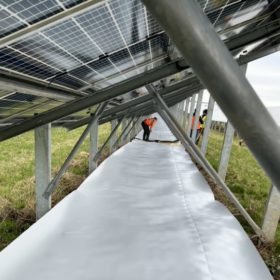
Germany-based Solmax has developed a reflective membrane made of polyethylene resins and coated with a thin white polyethylene layer that reflects ultraviolet (UV) rays. The company claims the membrane can increase the energy yield of a bifacial PV project by between 5% and 20%, depending on the plant configuration.
Putting bifacial modules to the test
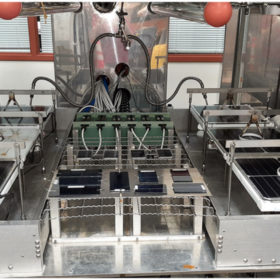
US scientists recently put different bifacial solar cells and modules through a series of tests at elevated temperature, humidity, voltage and mechanical stress levels. The tests revealed a range of light-induced and potential-induced degradation mechanisms that modules will likely suffer in the field.
Sol Systems develops bifacial solar project with pollinator habitat
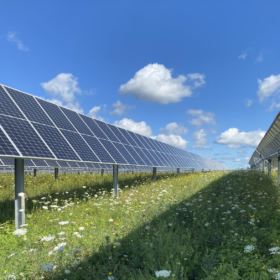
The Monroe County Water Authority recently flipped the switch on a 5 MW ground-mounted solar array in Penfield, New York.

Backward ray tracing for fast energy yield simulations
Scientists in the Netherlands have developed a model to forecast the energy yield of a PV system. It is able to take into account factors such as partial shading and multiple module orientations. Tested against a reference cell and pyranometer, the model showed less than 5% error, and the scientists claim their approach is up to three orders of magnitude faster than more common approaches using complex ray tracing.
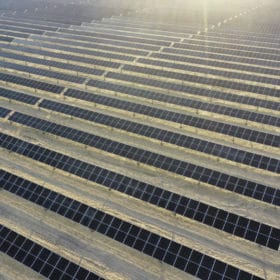
Oman inaugurates 500MW Ibri 2 solar field
Some 1.5 million bifacial panels make up the power plant in Ad-Dhahirah governorate which was constructed in just 13 months by ACWA Power, the Gulf Investment Corporation and Kuwaiti developer Alternative Energy Projects Co.

India’s solar module manufacturing capacity on track to soar 400% in four years
Ratings agency Crisil estimates India will have 38-43GW of annual solar module manufacturing capacity by the end of March 2025. Production capacity will be driven by strong domestic demand, favorable government policy, raised module conversion efficiency, and price competitiveness, according to the ratings agency.

‘World’s biggest TOPCon solar plant’ begins generating
Solar manufacturer Jolywood, which supplied almost 500 MW of its bifacial tunnel oxide passivated contact panels for Oman’s Ibri II facility, has claimed the power plant is the biggest to date to deploy the high-efficiency technology.
