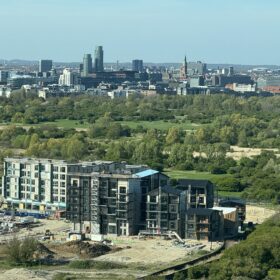
Solar to power Denmark’s largest energy community
Denmark’s largest energy community is now under construction, featuring more than 30,000 sqm of solar rooftops with a total capacity of about 4 MW. The project will use building-integrated photovoltaics (BIPV) on pitched roofs and building-attached photovoltaics (BAPV) on flat roofs from Danish specialist Solartag.

Danish startup launches solar tile for pitched roofs
Solartag has developed a 71 W solar tile with a weight 14.2 kg/m² and a power conversion efficiency of 16%. The new product relies on black PERC cells and is standardized for mass production, according to the manufacturer.
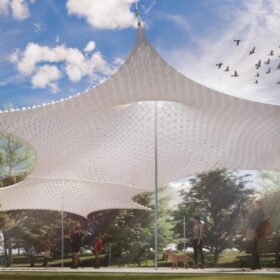
U.S. researchers developing photovoltaic dual-axis canopy
The “morphing skin” would track sunlight and have the flexibility and surface area to wrap across large surfaces, such as buildings and stadiums.
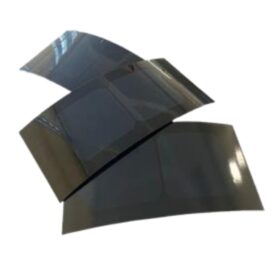
Izpitek unveils products to transform inert surfaces into PV systems
Izpitek is launching a new product line using patented tech to embed PV cells in composites, cutting weight by up to 95%.
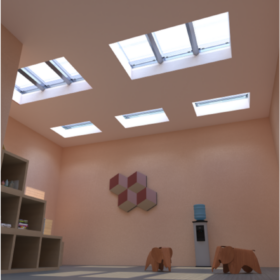
Semi-translucent solar window based on concentrated photovoltaics
Researchers in Spain have designed a PV window that performs active daylighting management while producing electricity. The system can reportedly ensure high power density, as it harvests all the direct light incident on the aperture area.
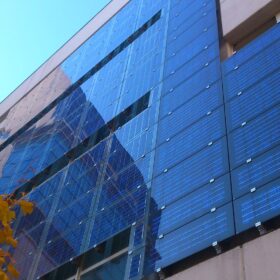
Technical guidebook for building-integrated photovoltaics
As the global transition toward sustainable energy intensifies, building-integrated photovoltaics (BIPV) has emerged as a critical innovation in merging renewable energy with architectural design. The recently published guidebook “Building-Integrated Photovoltaics: A Technical Guidebook,” edited by IEA PVPS Task 15 experts Nuria Martín Chivelet, Costa Kapsis, and Francesco Frontini, offers a comprehensive resource for architects, engineers, and urban planners looking to integrate BIPV into the built environment. This article explores the book’s key insights, including applications, challenges, and future pathways.

Colored modules for building-integrated photovoltaics
Taking inspiration from the 3D photonic structures on a Morpho butterfly’s shimmering blue wings, scientists at Germany’s Fraunhofer Institute for Solar Energy Systems ISE have developed colored solar panels that can be incorporated into a building’s exterior practically invisibly while maintaining high efficiency.

Polyshine Solar unveils ultralight, flexible rooftop solar panels
The Chinese manufacturer said its new flexible modules have an efficiency of up to 20.1% and a weight of only 7.5 kg, or 2.92 kg/m2. The new products have purportedly a light transmittance of over 91% and “ultra-high” UV blocking ability.
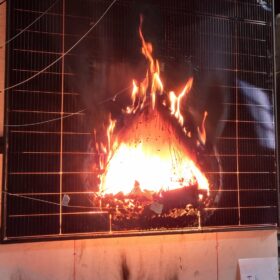
Assessing impact of fire on PV facades
An international research team has analyzed which factors contribute to fire accidents in PV facades and has found that the distance between the wall and the photovoltaic modules plays a crucial role. The scientists also said project developers should attentively consider what combustible materials are embedded in the wall cavity.
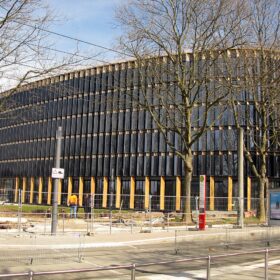
IEA-PVPS calls for harmonized testing, certification for building-integrated photovoltaics
The latest report from the International Energy Agency’s (IEA) Photovoltaic Power Systems Programme (PVPS) says the building-integrated photovoltaics (BIPV) industry is facing significant challenges due to a lack of clear testing and certification procedures. It says international consensus and the harmonization of certification processes will be crucial for widespread adoption of the technology.
